Google quietly shipped a surprise on October 8, 2026: AI Edge Foresight, a free experimental note-taking app for macOS that runs its AI entirely offline, on your machine. You type rough, hurried shorthand during a meeting or lecture; a split-screen view simultaneously renders a polished, structured version. Nothing leaves the device, there is no subscription, and the model doing the work is small enough to live on your laptop. This is Google's most consumer-facing push yet into on-device AI — and it lands squarely in a category, meeting notes, that has so far been dominated by paid cloud tools. Here is what Foresight does, what powers it, where it genuinely helps, and where it falls short.

What Foresight actually is
Foresight comes out of Google AI Edge, the company's initiative for moving models from the cloud onto devices themselves. The first release targets a specific audience with specific pain: researchers, writers, and students who juggle large volumes of documents and notes and want an assistant that never uploads their material anywhere. In practice the app does four things:
- Shorthand-to-prose conversion: as you type abbreviations and half-sentences, a side panel composes the clean, readable version in real time — a workflow reviewers immediately compared to Granola, minus the subscription and the cloud.
- A built-in assistant powered by Gemma 4, Google's open model family, which answers questions about your notes, summarizes them, and rewrites passages on demand.
- Document ingestion: import PDFs, Google Docs, Office files, Markdown, and even browser bookmarks, then search and cite across them.
- Local semantic search over everything above, indexed on-device.
Under the hood: EmbeddingGemma 2, a 740M-parameter retriever
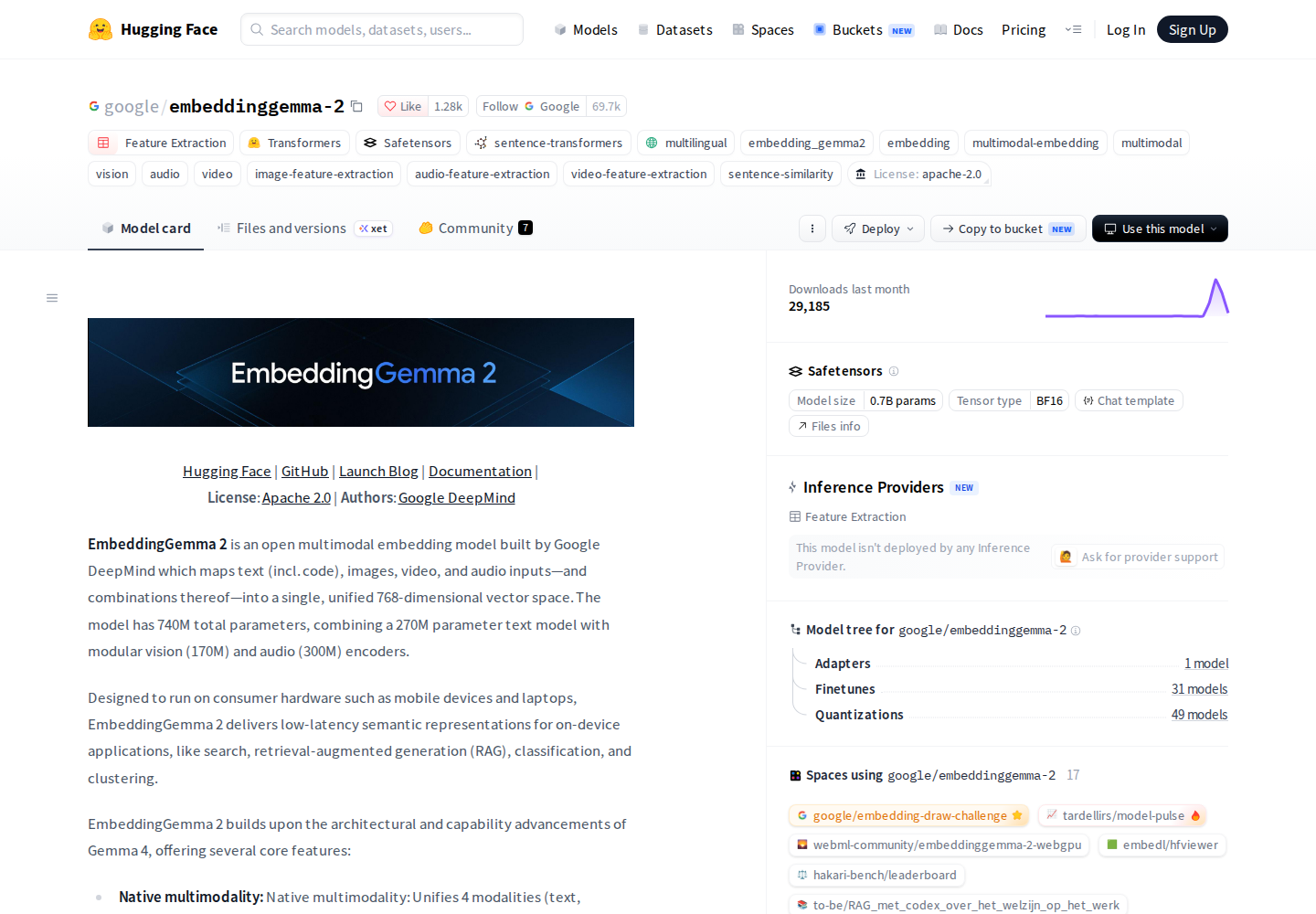
The technical detail that separates Foresight from a marketing demo is that Google published the retrieval engine openly. EmbeddingGemma 2 — the embedding model that indexes and searches your library — is live on Hugging Face under Google's official account, first published on September 14, 2026, at just 740 million parameters. For scale: that is hundreds of times smaller than frontier chat models. That is fine for the job, because "understanding text to find it again" is a far lighter task than "generating long reasoning." The choice tells you the design priority: instant, private, runs-anywhere retrieval over raw power.
Why "offline" is the whole point, not a footnote
Three groups of users have been waiting for exactly this:
Privacy-constrained professionals. Lawyers, consultants, healthcare workers, journalists handling sensitive sources — anyone under NDA or data-protection rules has had to say no to cloud note-takers. With Foresight, the compliance answer is structural: the data physically never leaves the laptop, so there is nothing to leak, subpoena, or train on.
Cost-sensitive heavy users. Every cloud AI call costs the vendor money, which eventually becomes your subscription or your usage cap. A local model runs at your machine's speed, with no monthly quota and no throttling when the vendor's servers get busy.
The badly-connected. Planes, trains, conference Wi-Fi, entire regions with unstable connectivity — an assistant that works identically at 35,000 feet is not a gimmick outside big metros. A tool that degrades because the hotel Wi-Fi dropped mid-session loses exactly the moments you needed it for.
What this means for you as a content creator
- Free meeting-to-draft pipeline. If you capture video ideas and interview notes during calls, this is currently the cheapest path from chaos to usable drafts — zero dollars, zero accounts beyond the download.
- Your research archive becomes searchable by meaning. Import your old reference PDFs and query them semantically — a capability that until recently required paid tools.
- Non-English reality check. Small on-device models lag in languages other than English. If your workflow is Arabic-heavy, test before committing — English polish is noticeably ahead. For reliable Arabic drafting you may still prefer a platform built Arabic-first, like ARWriter's toolset.
- Pricing pressure is coming to this whole category. Google entering at zero makes "cloud note-taker at $10–18/month" a defensive position. Expect consolidation or price drops among competitors within months.
- A signal for your own products: if you build content tools, on-device is now credible for retrieval and summarization — plan for users who ask "does this work offline?"
- Think twice before putting client material in any cloud note-taker. Even where tools claim strict retention rules, an on-device option removes the question entirely — a line you can give clients verbatim in your privacy policy, and one that increasingly wins deals where data handling is evaluated.
Quick comparison against today's default choices
| Tool | Offline | Privacy model | Price | Platform |
|---|---|---|---|---|
| Google AI Edge Foresight | Fully local | Data never leaves device | Free (experimental) | macOS only |
| Granola | No — cloud | Audio/text sent to cloud | Subscription | macOS primarily |
| Notion AI | No | Cloud | Within Notion plans | All platforms |
| Apple Notes + ChatGPT integration | Partial | Mixed | Free tier / subscription | Apple ecosystem |
Honest limitations — read before downloading
- macOS only right now. No Windows version exists and Google has announced no date for one. Windows users are simply out for now.
- Optimized for Apple Silicon. The experience is built around M-series chips; older Intel Macs are not the priority and may struggle or fail.
- Experimental first release. Expect rough edges, occasional formatting quirks in the polished output, and missing integrations. Do not make it your only archive yet.
- 740M parameters has a ceiling. Retrieval, summary, and tidy-up: excellent. Deep multi-document reasoning: still a frontier-model job.
- English-first behavior. Unofficial in practice: small models degrade in other languages, and Google has not published a supported-language list for the app itself.
Bottom line
If you are on a Mac and touch notes and documents daily, there is no reason not to install Foresight today — the price is zero and the privacy story is airtight. If your work is Windows-bound or centered on non-English writing, wait for the category to mature; the signal matters more than the app for now. And when your notes need to become published content — drafted, edited, imaged, and scheduled in one place — that is a different job, and ARWriter covers it from $4.99/month, with a prompt library to keep your voice consistent across every piece.
Frequently asked questions
Is Google's Foresight app really free?
Yes. The current experimental build is a free download from Google's official developer site, with no subscription, no usage cap, and no payment card required at any point.
Does Foresight work completely without internet?
Yes. Conversion, summarization, and search all execute locally on your machine; your notes are not sent to Google servers. That is the core of the AI Edge project.
When will Foresight come to Windows?
There is no official Windows announcement yet — the first release is macOS-only. Treat any specific date you see elsewhere as speculation unless it comes from Google directly.
How is it different from Granola or Notion AI?
Execution location and price. Foresight runs entirely on-device and costs nothing, while Granola and Notion AI process your material in the cloud under monthly subscriptions. The trade-off: cloud tools are currently more polished for advanced team workflows.
Which Macs run Foresight well?
Modern Macs with Apple Silicon (M-series) deliver the intended experience, since every AI operation runs on the processor itself. Older Intel-based Macs are not the optimization target for this first release and may perform poorly or be unsupported.
Sources: official Google AI Edge Foresight page and Google's EmbeddingGemma 2 model release on Hugging Face. Release date: October 8, 2026.