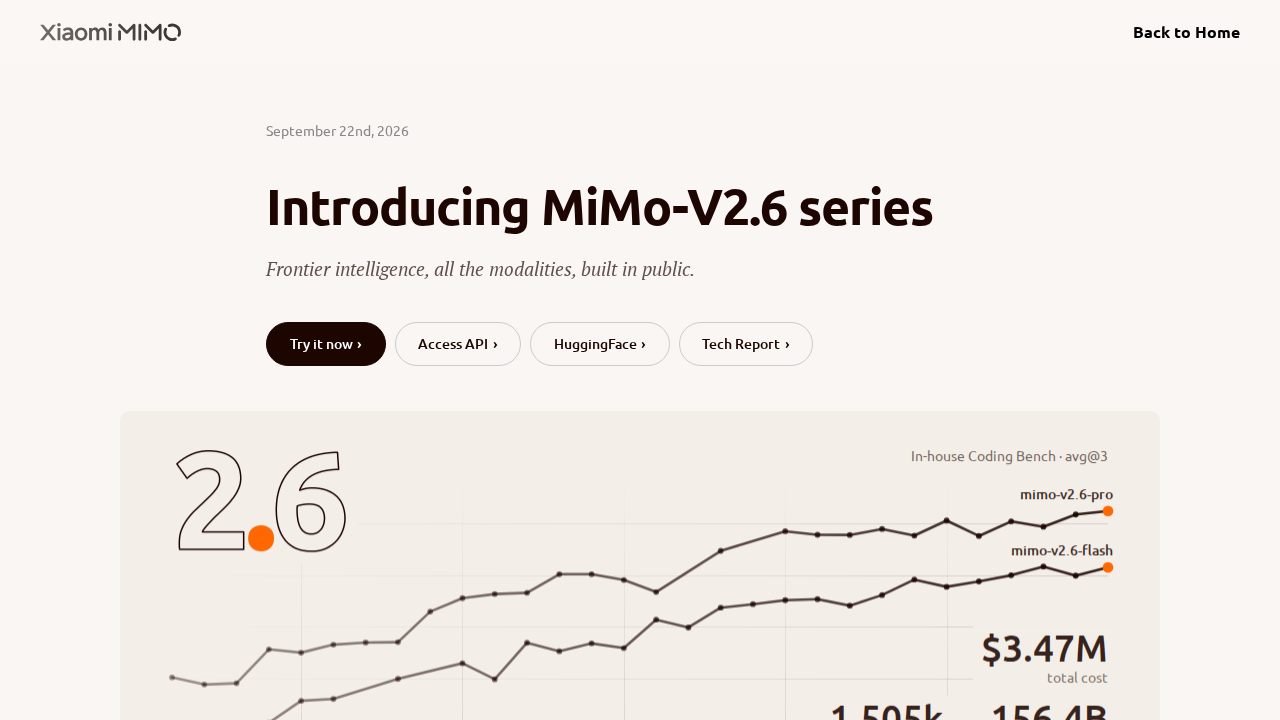
In what independent coverage is calling the strongest open-weights launch of the season, Xiaomi opened the weights of its new generation — Xiaomi MiMo-V2.6 — to everyone on September 21, 2026: three models under a commercially free MIT license, headlined by MiMo-V2.6-Pro, a sparse Mixture-of-Experts model with 1.02 trillion total parameters (42 billion activated per token), a one-million-token context window, and native understanding of text, image, video, and audio in a single model.
The weights went live on the team's official Hugging Face page on the evening of September 21 UTC, alongside an official announcement page and a full technical report PDF. Within hours, the story sat at the top of Hacker News with more than 940 points and four hundred comments — a level of attention almost unheard of for a model from a phone maker.
What exactly is MiMo-V2.6?
The new family ships in three editions, and the differences between them are practical rather than cosmetic:
| Edition | Total / activated params | Realistic use |
|---|---|---|
| MiMo-V2.6-Pro-RL | 1.02T / 42B | The flagship — for large infrastructure and cloud serving |
| MiMo-V2.6-Flash-RL | 309B / 15B | The capability-per-cost balance point |
| MiMo-V2.6-Distill-Qwen-9B | 9B | Local experiments on consumer hardware |
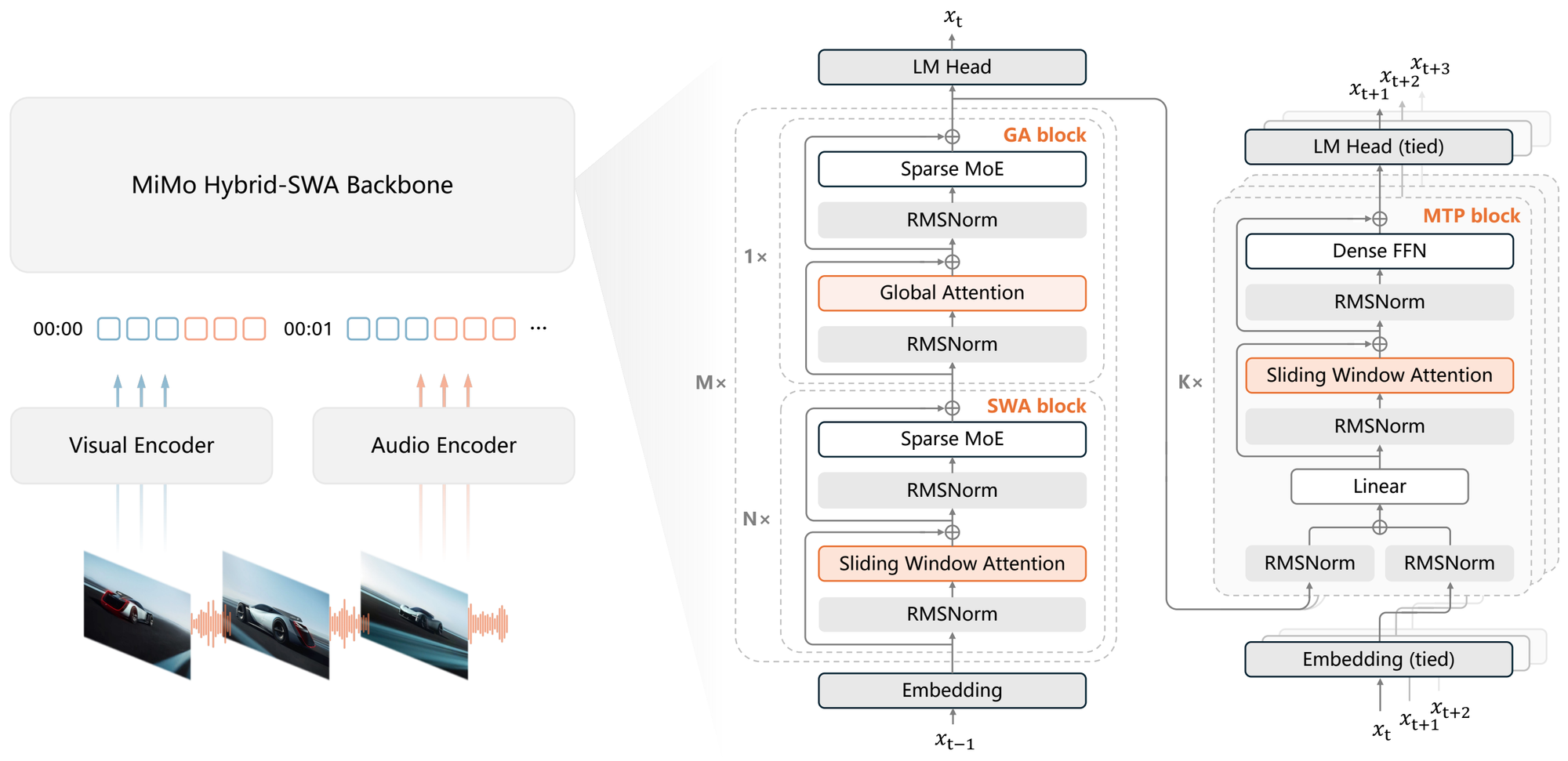
All three support up to a one-million-token context and accept text, images, video, and audio together — what the official card calls "native omnimodal." Xiaomi builds its performance story on a methodology it calls "Scaling Reinforcement Learning Toward Self-Improvement": a single mixed reinforcement learning run (You Only RL Once) spanning coding, general agents, visual tasks, and cybersecurity, on very large batches (1,568 prompts × 16 rollouts per step), with an agentic grading system that compares rollouts against each other instead of binary pass/fail, followed by a multi-teacher distillation phase (MOPD2) that extends the model to tasks that are hard to verify automatically. Per coverage from The Decoder, one of those teachers was Anthropic's Claude.
The numbers: where does Xiaomi sit against the giants?
The figures below come from the official model card tables — the basis for the "top open-weights model" framing adopted by VentureBeat and TechNode's coverage:
| Benchmark | MiMo-V2.6 Pro | Claude Opus 5 | GPT-5.6 Sol | Claude Fable 5 |
|---|---|---|---|---|
| DeepSWE v1.1 (software engineering) | 71.9% | 74.0% | 73.0% | 70.0% |
| AutomationBench (automation) | 53.1% | 50.3% | 45.8% | 46.2% |
| Toolathlon-Verified (tool use) | 76.9% | 80.6% | 74.9% | 77.9% |
| Agents' Last Exam (agents) | 31.6% | 31.6% | 30.8% | 25.7% |
| MiMo VisualCoding | 72.3% | 70.0% | 73.4% | 69.1% |
Notice the single most important comparison row, the one that tells the real story: Xiaomi's previous generation, MiMo-V2.5 Pro, scored just 19.0 on DeepSWE. Jumping to 71.9 in one generation — into the middle of a table of closed models that cost billions to build — is the substance behind the headlines, more than any single absolute number.
What this means for you as a content creator
1. MIT means actually free — including commercially. The crucial difference from many recent "open" releases is that Xiaomi attached no research-only restrictions. When we covered the Qwen-Image-2.1 launch, its license barred commercial use; here you can build a paid product or service on top of MiMo-V2.6 without asking permission or paying royalties. For anyone building writing or content-automation tooling, that rewrites the cost equation from the ground up.
2. The realistic path today is hosted services, not self-hosting. The official recipe for serving Pro calls for two nodes with sixteen GPUs — not an option outside serious infrastructure. But Xiaomi shipped a full ecosystem alongside: an official API platform, a free studio for trying the model, a MiMo Desktop app, and OpenRouter availability typically follows within days. For most readers the practical picks are Flash for economical performance, or the 9B Distill for local experiments on a single card.
3. A one-million-token context unlocks a different class of tasks. Feeding an entire book, a podcast archive, or all your project documentation into a single request is now an open-model capability. We noted the same direction when covering Qwen3.8-Omni-Flash: the open ecosystem is now competing on digesting whole projects, not answering short prompts.
4. Write smarter, not just cheaper. An open model does not automatically belong in every workflow. The mix we see working in practice: a hosted service for daily production — a ready prompt bank like ARWriter's prompt library for drafts you can publish directly — combined with an open model like MiMo for the jobs you control end-to-end: mining your own archive, automating recurring research, or experimenting with content agents. For teams already building their own tooling, routing between a cheap-to-serve open model and a premium hosted one is the equation that lowers the bill without lowering quality.
5. Watch who is entering the arena. Chinese business press reported that the MiMo team, led by researcher Luo Fuli, burned through more than 20 million yuan in six days of training — a new pattern of hardware-and-cash-rich companies entering the model market without betting on subscription revenue. Every additional player like this compresses token prices globally, and the direct beneficiaries are people who build content and tooling on top of these APIs.
Honest limits before you get dazzled
Every published benchmark is about agents, coding, and security — none about writing. We went through the official card's tables: there is no benchmark for creative or marketing copy quality, and none for Arabic robustness. The model was built and validated for agentic and automation tasks; assuming it is automatically "the best writer" is the classic mistake that follows every strong launch.
Arabic is not on the official list. The card lists exactly two languages: English and Chinese. That does not mean the model fails at Arabic, but it means there is no stated guarantee or calibration — your own testing on your own content is the only honest evaluation.
Size is a practical burden. A trillion-parameter Pro is not something you "download tonight," and even the 309B Flash needs serious hardware. The only genuinely consumer-local option is the 9B Distill.
The ecosystem skews English/Chinese. The studio and official platform are designed first for those two markets, and parts of the documentation are Chinese-only. The real near-term beneficiaries are builders on top of the API, not end users.
Frequently asked questions about MiMo-V2.6
Is MiMo-V2.6 really free?
The weights are free under an MIT license that permits commercial use, modification, and redistribution. What you pay is only the cost of running it: electricity and GPUs if you self-host, or per-token prices if you use it through an API platform or OpenRouter.
What is the difference between Pro, Flash, and Distill?
Pro (1.02T total / 42B activated) is the flagship for large-scale serving, Flash (309B / 15B) balances capability against cost for practical services, and Distill-Qwen-9B is a small distilled checkpoint built on Qwen3.5-9B for local experiments and research.
Does MiMo-V2.6 support Arabic?
The only languages declared on the official model card are English and Chinese. There is no stated Arabic support and no published Arabic benchmark — test it on your own text before relying on it.
Where can I try MiMo-V2.6 today?
Through the official MiMo Studio, the MiMo Desktop app, Xiaomi's API platform, OpenRouter once listed, or by downloading the weights from Hugging Face and ModelScope if you have the hardware.
Why is this launch getting so much attention?
Because an MIT-licensed open model competing in the range of closed models that cost billions to train — with a jump from 19.0 to 71.9 on a single engineering benchmark between generations — rarely happens, let alone from a company not primarily known for language models.
The bottom line
MiMo-V2.6 matters not because it will change your writing tomorrow morning, but because it widens the moat open models are digging under the closed wall: near-frontier performance, a clean license, and an omnimodal architecture ready to build on. The practical takeaway for content professionals: add it to your open-alternatives list and try it as it lands in services you already use — and if your priority today is producing content rather than running infrastructure, a ready workflow on ARWriter remains the fastest path while self-hosting matures.