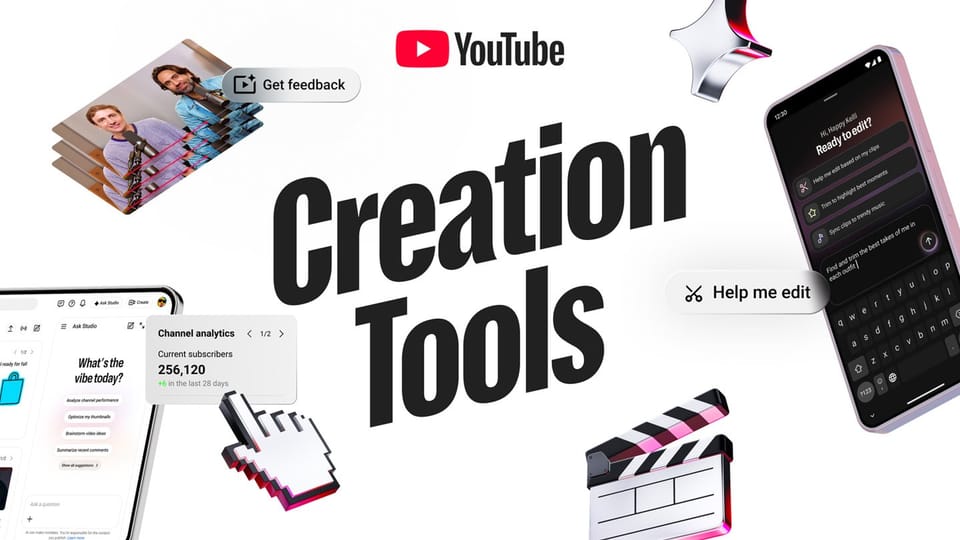
At its annual Made on YouTube event on September 23, 2026, YouTube quietly redraws the line between a video platform and a video studio. The headline items: a chat-driven Gemini editing assistant for Shorts and the YouTube Create app, native A/B testing for entire video cuts, thumbnails that adapt to each audience segment, background refreshes for aging uploads, and a likeness-detection system that will soon pair face matching with speaking-voice detection. If you publish on YouTube, your production stack just got an offer it can't refuse — built directly into the place your videos already live.
The editing assistant: describe the cut, chat until it's right
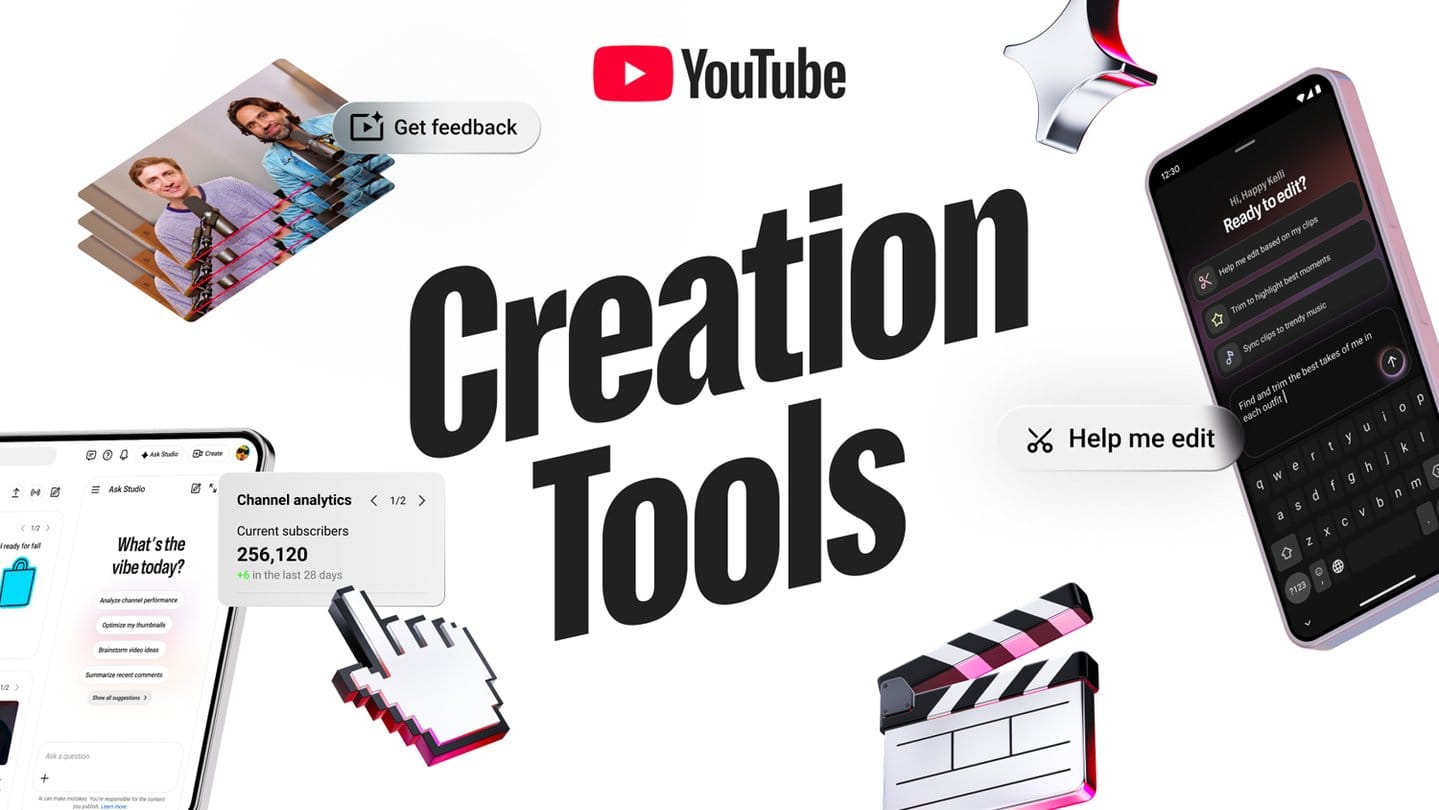
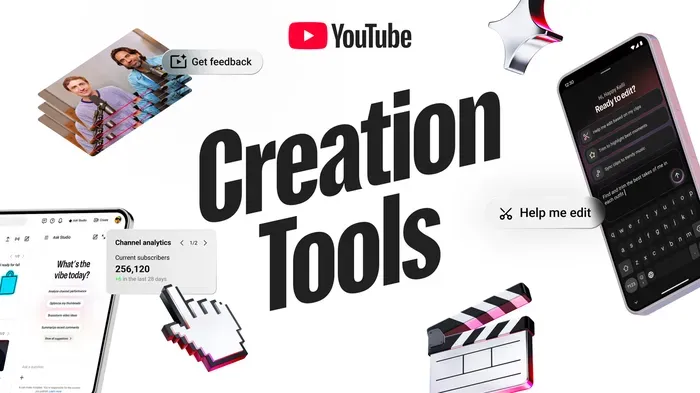
The centerpiece is conversational editing. You start from a suggested prompt or write your own, the assistant produces a first draft of the edit, and from there you refine by talking: reorder frames, trim dead air, sync the music to the beat. When words stop being the fastest way, you drop back to the manual timeline — the chat layer sits on top of editing, not instead of it.
This is not a cold start. Gemini Omni arrived in Shorts and the YouTube Create app earlier this year — we walked through that first wave when it landed — and YouTube says that in August 2026, hundreds of thousands of channels were using it every day. What's new is the scope: the assistant now behaves like a junior editor who knows your footage, not a one-shot generator, as detailed in the official announcement from YouTube VP Aparna Pappu. For solo creators and small teams, that is the difference between a gimmick and a production step you actually plan around.
Testing graduates from thumbnails to the video itself
YouTube's title-and-thumbnail A/B testing has been quietly massive: since its official 2024 rollout, creators have run more than 40 million experiments. The next step, announced as "coming soon," is video A/B testing — up to three different cuts of the same video, served to real audience segments, to learn which hook actually holds attention.
Until now, this kind of front-hook optimization lived in third-party analytics tools, guesswork, or channels large enough to run their own tests. Bringing it native to Studio collapses that advantage. Paired with it:
- Channel-matched thumbnails — generated in your channel's visual style rather than generic AI imagery.
- Dynamic thumbnails — YouTube recommends "the best of three options to different segments of your audience," meaning two viewers can legitimately see different thumbnails for the same video.
- Background thumbnail monitoring — Ask Studio reviews your older uploads, proposes refreshed thumbnails, and tests them automatically, giving back-catalog videos a second lease on life.
Ideas and drafts: Studio becomes a research room
Two new destinations — Insights and Research, on web and mobile — surface your past performance alongside "outlier videos": clips that overperformed for channels around your size. It's YouTube institutionalizing the practice of mining other people's wins for your next idea. And once a draft is ready, a new feedback feature reviews pacing, structure, and storytelling before you publish — a second pair of eyes that never sleeps.
For busy channels, there's also an opt-in, in-testing AI comment moderation system that learns your personal moderation style and applies it to incoming comments. YouTube's own framing is worth noting: in its first GenAI trends report, the company found 72% of US video posters aged 14–44 used AI for creating or editing content in the past year. The platform is building for the majority, not the edge case.
Your face was the easy part; your voice is next
The protection story got a meaningful upgrade. Likeness detection — automated discovery of videos that use your face without permission — is now eligible for billions of channels, and it's heading to the mobile app so you can enroll, review matches, and act from anywhere. The bigger news: speaking-voice detection will be integrated with facial detection "later this year" to improve match accuracy. For creators targeted by AI-cloned voices in scam clips, a double match on face and voice makes takedowns dramatically easier to justify. Enrollment takes minutes today at the official likeness detection help page — worth doing before you need it.
What this means for your workflow
Practically, three shifts. First, tool sprawl shrinks: idea research, rough editing, and thumbnail testing can now happen inside one product, which means fewer subscriptions and less file shuffling. Second, your back catalog becomes an asset again — automated thumbnail refreshes can resurface videos that algorithms had quietly buried. Third, protection is finally proactive rather than reactive.
A caveat the announcement doesn't resolve: YouTube has not published per-feature language or market lists, and no pricing changes were mentioned — everything announced sits inside existing Studio and Create tooling. Rollouts at this scale are always staggered, so treat availability in your own dashboard as the source of truth.
Quick comparison: native tools vs. your current stack
Against dedicated editors like CapCut or the AI suites creators bolt together, YouTube's assistant wins on integration: the cut lives where it publishes, and tests run on your real audience rather than a proxy panel. Dedicated tools still win on frame-precise manual control, advanced templates, and long-form polish. The rational setup for 2026 is hybrid — native assistant for speed and first drafts, your specialist tool for finishing. The same logic applies to writing: a video needs a script, a description, and a companion article, and an Arabic-ready writing platform like ARWriter's research and article tools handles the text side of that pipeline while Studio handles the footage. (Our earlier look at voice-model developments covers the audio side.)
Honest limits before you rebuild your pipeline
Read the fine print and gaps remain. Video A/B testing is "coming soon" with no date; voice detection is "later this year"; comment moderation is in testing and opt-in. The 72% statistic covers the US market, not the world. And any suggestion engine inside a single platform reflects that platform's own view of your audience — your judgment about what your viewers actually want still outranks the recommendation card. These are direction-of-travel announcements as much as shipping features.
The rest of the event in sixty seconds
Beyond creation tools, YouTube announced real-time auto-dubbing for live streams — a genuine door to non-native audiences without a translation team — plus Shorts Series with seasons-and-episodes structure aimed at microdramas, and Custom Feeds that let viewers describe what they want and get a Gemini-built personalized homepage (coming soon). On the commerce side, the YouTube Shopping affiliate program reaches 35 countries by the end of 2026, Amazon joins as an international partner, and product tags will auto-localize offers by viewer location, while Ask Studio will soon draft brand replies and pitch materials. Full details are in CEO Neal Mohan's official roundup.
Start with the script
Faster editing and smarter testing amplify whatever you feed them — they don't invent the idea. Creators who win the next cycle will pair these native tools with a writing workflow that produces the script, the description, the companion article, and the social posts in one pass, using a platform built for their language such as ARWriter. YouTube will cut, sync, and test. The story is still yours.
FAQ
When will video A/B testing be available on my channel?
YouTube announced it on September 23, 2026, as "coming soon," with no date or market list. Expect a staged rollout; watch the "What's new" panel in YouTube Studio on web and mobile.
Are the new Studio AI tools free?
All announcements were framed inside existing YouTube Studio and YouTube Create tools, and no new paid tier was mentioned at publication time.
Does the conversational editing assistant work in languages other than English?
The announcement did not include a supported-language list. Availability in your account is the reliable signal — geographic staggering is the usual reason a feature hasn't appeared yet.
How do I protect my face and voice from AI deepfakes on YouTube?
Enroll in likeness detection from your channel settings (now eligible for billions of channels, with mobile management coming), and watch for speaking-voice detection, which will be combined with facial detection later this year for stronger matching.
What's the difference between dynamic thumbnails and regular thumbnails?
A regular thumbnail is one image shown to everyone. Dynamic thumbnails let YouTube recommend the best of up to three options to different audience segments, so different viewers may see different thumbnails for the same video — automatically.