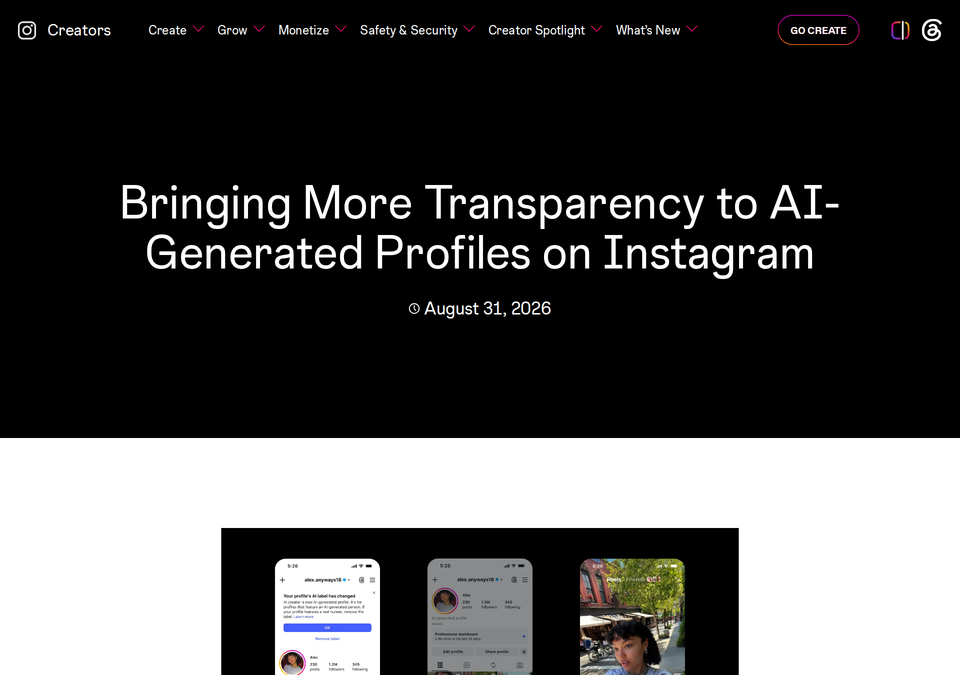
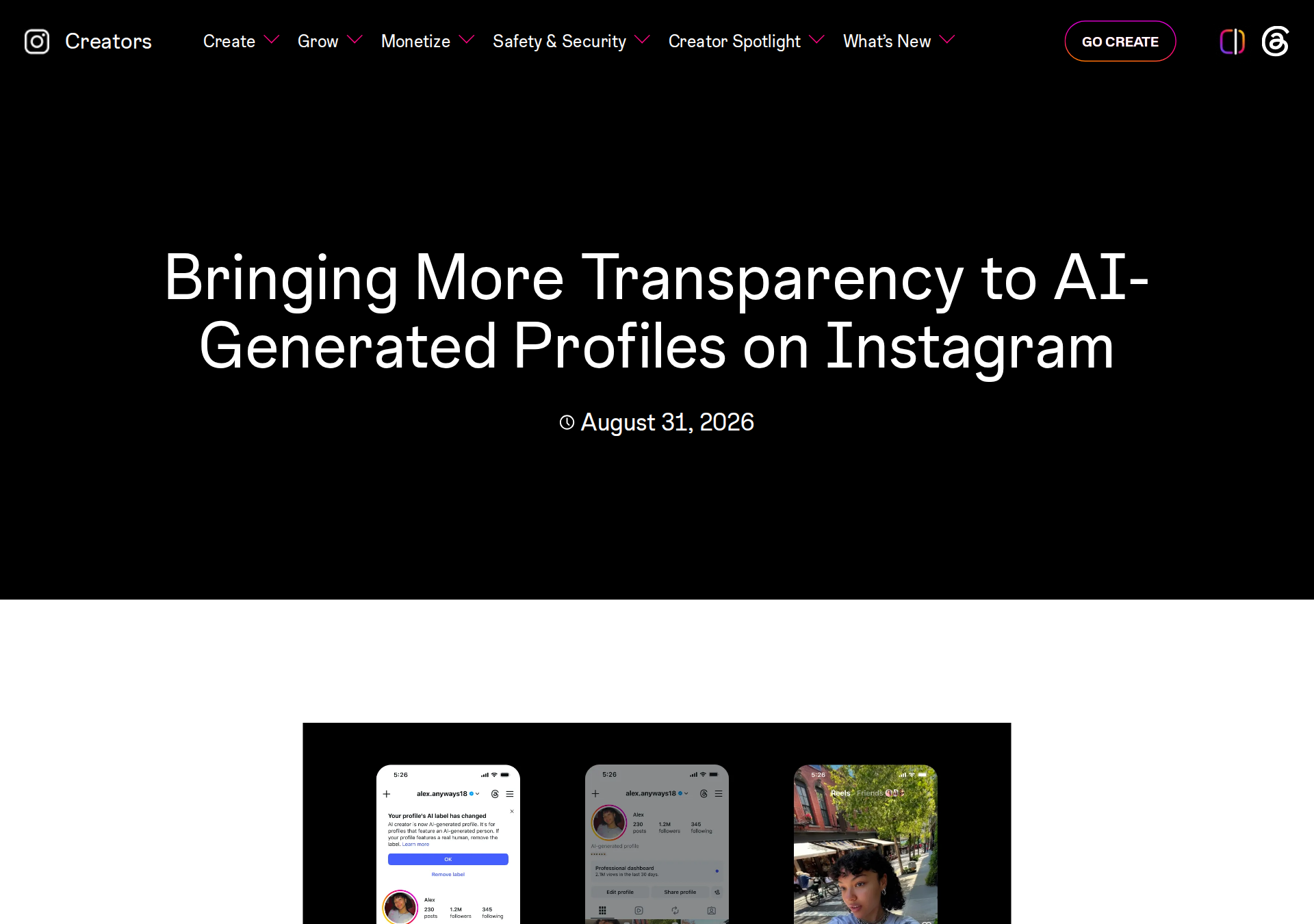
Instagram made a policy move on August 31, 2026 that every creator, agency, and social media manager should understand precisely, because it draws a line that was blurry for years. The platform announced, via its official creators blog, that the "AI creator" label is being renamed "AI-generated profile" — and, more consequentially, that profiles featuring an AI-generated person without the label will now face reach limits.
The company's reasoning is blunt: "We've heard that people don't like seeing a profile that seems human, only to find out later that the person featured is AI-generated. They want to know when a profile features an AI-generated person." In other words, Instagram is not fighting AI-generated content — it is fighting undisclosed virtual identity.
What exactly changed today
Three practical changes took effect according to the announcement's own wording:
- A clearer label name. The "AI creator" label, tested since earlier this year, becomes "AI-generated profile" — a name that describes the thing itself: the profile features a person who is not real.
- Enforcement for unlabeled virtual-person profiles. Profiles that feature an AI-generated person and skip the label will see their reach limited. Detected profiles get notified and can check Account Status to see whether they are "no longer eligible to appear in recommendations" — which, as The Verge notes, effectively means losing exposure to non-followers through surfaces like Reels and Explore.
- A review window for early adopters. Creators who already used the old label will see the new name and can confirm it still fits, or remove it if it no longer applies.
Notice what the policy is anchored to: identity, not production method. Nothing here penalizes a human creator for using AI in their workflow.
Who is affected — and who is explicitly exempt
The single most important sentence in the announcement for working creators is this one: "Creators who simply use AI tools as part of their creative process don't need to add the label." If you draft captions with an AI writer, generate images, or edit video with AI assistance, today's change does not apply to you.
The change effectively sorts accounts into three groups:
- Virtual-person profiles: accounts presenting a generated persona as their public face. These must add the label now, or accept declining discovery.
- Agencies and brands running AI personas: client accounts built around virtual influencers need a compliance pass today — contracts, deliverables, and reporting all assume recommendability.
- Everyone else: the winners. Human creators competing against undisclosed AI personas get a progressively fairer recommendation pool.
Instagram also addressed the fear that transparency is punished: creators who proactively add the label "will not see a change to their profile's reach." The penalty is reserved for concealment, not disclosure.
How to add the label (and how to recover if flagged)
The official path is short: edit your profile, toggle on "AI-generated profile," and the label begins appearing on your profile and alongside your content — unless the media itself already carries an AI label.
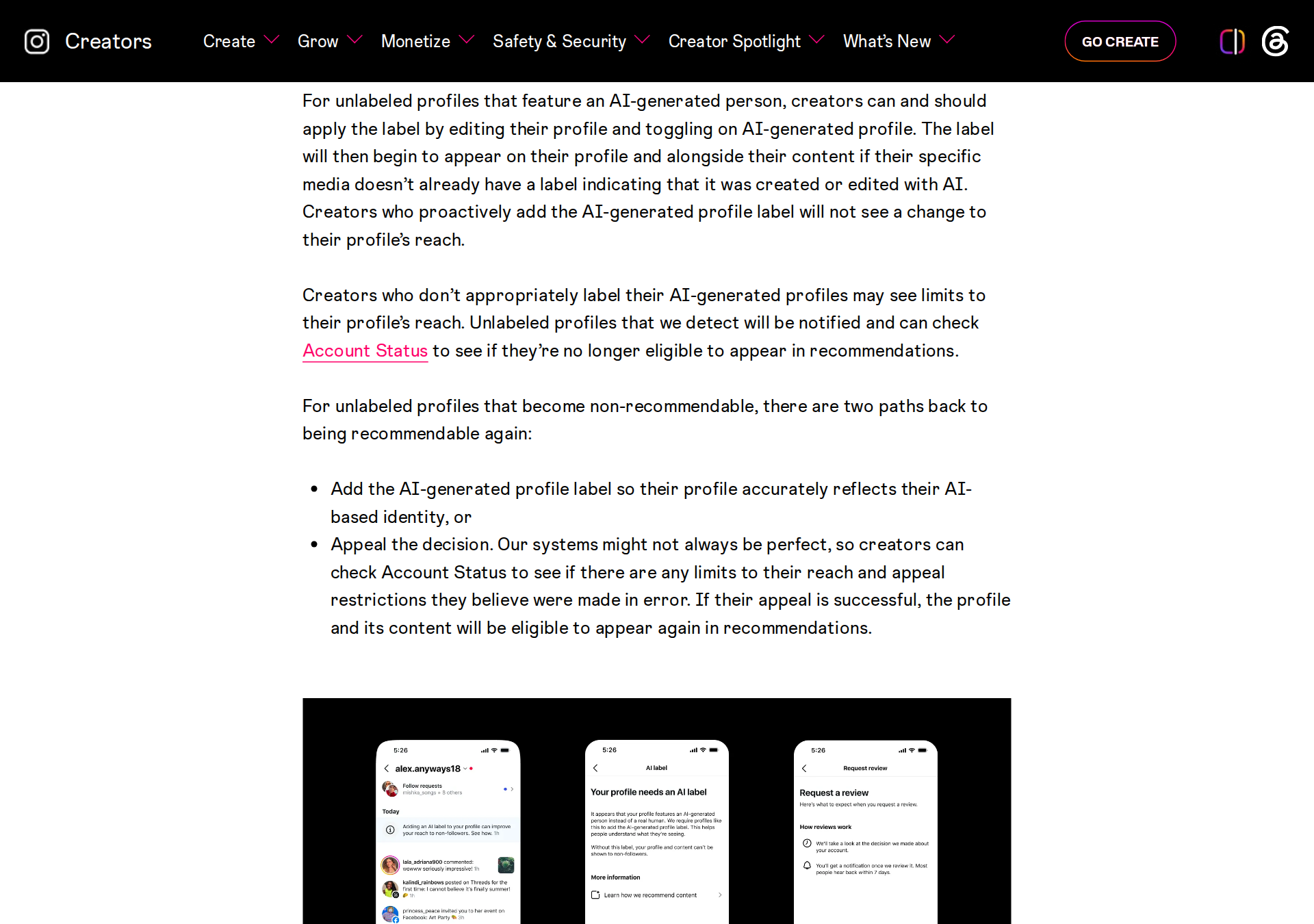
For profiles that slip out of recommendations, the announcement documents exactly two ways back. First, add the label so the profile "accurately reflects their AI-based identity." Second, appeal: "Our systems might not always be perfect," Instagram concedes, so creators can check Account Status for reach limits and appeal restrictions they believe were made in error — a successful appeal restores the profile and its content to recommendations.
What this means for your content operation
If your personal brand is you — a consultant, writer, designer, store owner — the direct impact is zero and the indirect benefit is real: some of the attention that undisclosed AI personas were capturing returns to creators who build genuine trust. That is the entire bargain Instagram is offering.
If you operate a generated persona, the calculus changed this morning. Labeling is no longer cosmetic; it is the price of discovery. The global experience so far suggests audiences do not flee a virtual character that is honest about being virtual — the reputational damage has always come from late discovery of the deception, not from the concept itself.
And if your relationship with AI is as a production tool — researching, drafting, designing, scheduling — you are in the safest and fastest-growing category. Teams that batch their content with an AI workflow platform, such as ArWriter's multilingual creation suite, sit entirely on the "tool use" side of Instagram's line: AI in the background, human identity in the foreground.
Old label vs. new label at a glance
| Aspect | AI creator label (old) | AI-generated profile (new) |
|---|---|---|
| Name clarity | Ambiguous; read as "creator who uses AI" | Precise: profile features a generated person |
| Status | Optional, in testing | Required for AI-person profiles to stay recommendable |
| Consequence of skipping | None formalized | Reach limits, notification, Account Status flag |
| Creators using AI tools | Common confusion | Explicitly exempt |
| Appeals | Not documented | Documented via Account Status |
It also helps to distinguish the two labeling systems Instagram now runs. The profile label introduced today is about the identity of the "person" in the account. The older content label applies to generated or AI-edited media. They answer different questions — who is speaking, versus how the asset was made — and one covers for the other only when the media already carries its own label.
Honest limits of this policy
- It is not a user-facing filter. Nothing announced today lets individuals hide all AI content from their feed; it is disclosure at the account level, not a control knob for consumption.
- Mistakes are expected. Instagram itself says its systems "might not always be perfect." False positives and misses are both likely in the early weeks, and the appeal flow is the only remedy.
- No regional breakdown. The announcement gives no phased rollout or country list; the language implies an immediate, global application.
- Reach is the whole game. Losing recommendations means losing the non-follower audience — for growth-stage accounts, that is close to an existential constraint, not a cosmetic one.
The bigger picture: platforms are closing the ambiguity era
Today's move is one tile in a larger mosaic. YouTube has already tightened its rules against inauthentic content designed to game discovery — we broke down what that means for AI-assisted channels in our analysis of YouTube's inauthentic content policy. Instagram's own head, Adam Mosseri, had publicly framed the debate over AI content in the feed weeks earlier. With today's enforcement step, the industry direction is unmistakable: use generative tools freely in production, but present a fabricated person without disclosure and your distribution shrinks.
For creators, the strategic conclusion is simple. Transparency has become a ranking factor of sorts — a trust signal that both audiences and algorithms now reward. The accounts best positioned for the next cycle are those that pair genuine human identity with heavy AI leverage behind the scenes.
Your next step
Run a quick audit instead of reacting emotionally. No virtual persona in your portfolio? You have nothing to do. Operating one? Add the label today, before detection finds you — voluntary disclosure preserves your reach in full. Flagged by mistake? File the appeal from Account Status immediately. And if your plan is to stay on the tool-user side of the line while shipping more content in less time, a platform like ArWriter's automated writing workflow is built for exactly that: scaling production without ever touching identity.
Frequently Asked Questions
Do I need to label AI-assisted content on Instagram after this change?
No. The new profile label applies only to accounts featuring an AI-generated person. Instagram explicitly exempts creators who use AI tools as part of their creative process; media-level AI labels continue to work as before.
Does adding the AI-generated profile label reduce my reach?
No. The announcement states that creators who proactively add the label will not see a change to their profile's reach. Limits apply to unlabeled AI-person profiles that get detected.
What is the difference between the profile label and the AI content label?
The profile label tells viewers the account features a generated person; the content label marks specific media as created or edited with AI. If your media already carries its own label, the profile label appears on the account without duplicating on the content.
How do I appeal if my profile is flagged incorrectly?
Open Account Status to see any reach limits, then submit an appeal from there. Instagram notes its systems are not perfect, and a successful appeal restores the profile and its content to recommendations.
Is this rolling out globally or only in some markets?
The announcement describes no regional phases or exceptions, implying a global, immediate application as of August 31, 2026.
Sources
- Official announcement: Bringing More Transparency to AI-Generated Profiles on Instagram — Instagram for Creators blog, August 31, 2026.
- Official help page: Check your Account Status on Instagram.
- The Verge: Instagram cracks down on AI accounts pretending to be human — August 31, 2026.