On September 21, 2026, SpaceXAI — the company behind the Grok family, formerly known as xAI — released Grok 4.7, its most capable model to date for coding and knowledge work. The headline detail for anyone producing content at scale is the pricing: the new model ships at the same price and speed as Grok 4.6, at $2 per million input tokens and $6 per million output tokens, with a fast variant running at twice the output speed for twice the price.
The announcement went live on the company's official newsroom, and the model is available today in Cursor and Grok Build, through the Grok API, across third-party coding harnesses — and in GitHub Copilot, as GitHub confirmed in its own announcement the same day.
What SpaceXAI actually announced
The company positions Grok 4.7 as "our most capable model for coding and knowledge work," built around three promises: it works longer on difficult tasks, checks its own work more carefully, and ships with the best-calibrated safeguards the company has shipped to date. The official launch tagline is blunt: "Twice as fast, at half the price of comparable models."
Under the hood, Grok 4.7 runs on a new, larger base model than Grok 4.6, trained through a longer reinforcement learning run weighted toward problems that take hours, not minutes. SpaceXAI also says the model was trained to natively understand the Grok Bot harness, improving conversational quality and general knowledge work — the exact category most writers, researchers, and marketers live in: drafting, summarizing, researching, and assembling long documents.
The quiet headline: documents and presentations
The most consequential line in the announcement for content professionals is easy to skim past: "Grok 4.7 is better at creating documents and presentations." On GDPval — a benchmark where AI handles tasks normally done by lawyers, nurses, and financial analysts — Grok 4.7 (at xHigh effort) scored 1695 Elo, up from 1605 for Grok 4.6, ahead of GPT-6 Astra (1542) and closing in on Claude Fable 5.1 (1735). On AA Briefcase, a benchmark for multi-hour office work, it posted 1657, beating both Grok 4.6 and GPT-5.6 Sol.
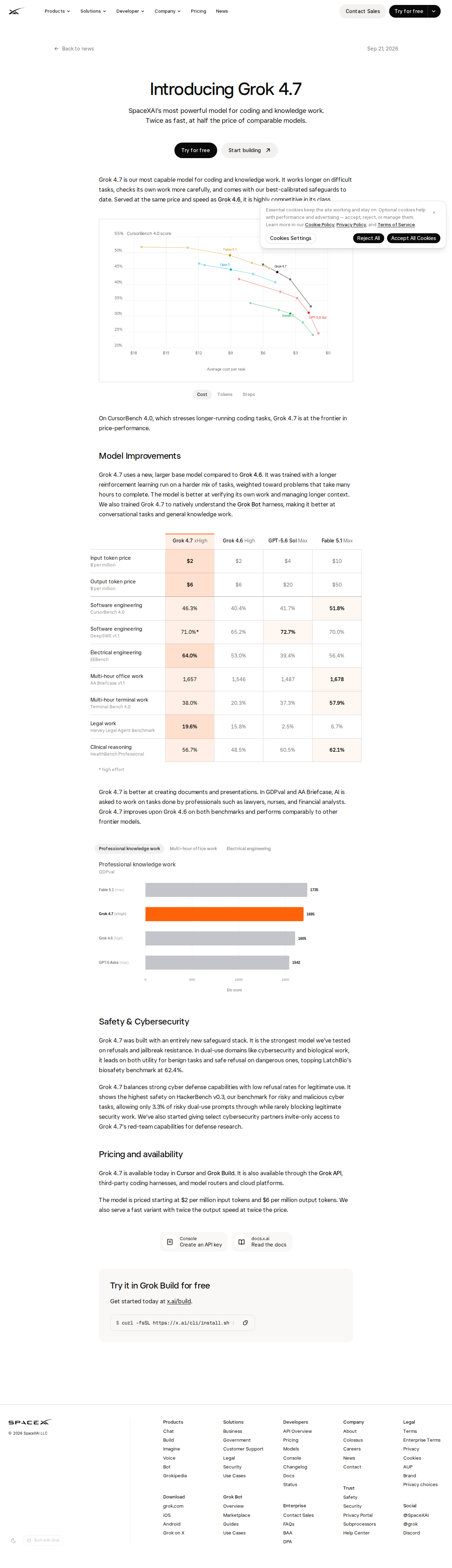
Those are not abstract numbers. They describe the requests you actually make on a Tuesday afternoon: "turn these notes into a client-ready deck," "draft a long-form article from these fifteen sources," "compile this research into a structured report." Claude Fable 5.1 still leads most tables — at $10 input / $50 output per million tokens, roughly eight times Grok 4.7's output price.
The official numbers
According to the official pricing page in xAI's developer documentation, Grok 4.7 offers a 500k-token context window, a knowledge cutoff of May 2026, and the following rates:
| Model | Input (per 1M tokens) | Output (per 1M tokens) | Context |
|---|---|---|---|
| Grok 4.7 (under 200k prompt) | $2.00 | $6.00 | 500k |
| Grok 4.7 (200k prompt and above) | $4.00 | $12.00 | 500k |
| GPT-5.6 Sol | $4.00 | $20.00 | — |
| Claude Fable 5.1 | $10.00 | $50.00 | — |
Note the long-context trap: requests that cross the 200k-prompt threshold are billed at the higher rate for all tokens, which matters if you routinely stuff entire project folders into a single call.
What this means for you as a content creator
1. Bulk production costs drop in practice. If you run a publication, an agency, or a content-heavy store and call APIs to draft and refine copy, the gap between $6 and $20 or $50 per million output tokens compounds fast at monthly volume. Grok 4.7 puts near-frontier knowledge-work performance at economy-tier pricing.
2. Long-horizon tasks got cheaper to attempt. The model's stated focus is work that stretches over hours: assembling a full file, reviewing dozens of sources, keeping a report coherent. The 500k context window lets you pass a small project in one request — just remember the 200k threshold doubles the rate.
3. You can try it free today. Grok 4.7 is live in Grok Build at no cost, in Cursor, and in GitHub Copilot for existing subscribers. That is enough to judge its output quality on your content before wiring up any paid API. And if you would rather skip the plumbing entirely, a ready-made Arabic-first writing and publishing workflow is exactly what tools like ARWriter's auto-writer are built for.
4. The Grok stack keeps stacking. We have covered this space as it evolved: the Grok 4.6 launch, then Grok Voice Transcribe 2.0 for speech-to-text. With 4.7, the family now spans writing and transcription at aggressive prices — a credible second vendor for anyone hedging against single-provider risk.
Quick comparison: where Grok 4.7 stands
From the official launch tables (highest effort level per model):
| Benchmark | Grok 4.7 | Grok 4.6 | GPT-5.6 Sol | Claude Fable 5.1 |
|---|---|---|---|---|
| CursorBench 4.0 (software engineering) | 46.3% | 40.4% | 41.7% | 51.8% |
| DeepSWE v1.1 (engineering tasks) | 71.0%* | 65.2% | 72.7% | 70.0% |
| AA Briefcase (multi-hour office work) | 1657 | 1546 | 1487 | 1678 |
| GDPval (professional work, Elo) | 1695 | 1605 | — | 1735 |
| Terminal-Bench 4.0 | 38.0% | 20.3% | 37.3% | 57.9% |
* A high-effort score, per the official announcement. (GPT-6 Astra does not appear in some tables because SpaceXAI's official comparison used GPT-5.6 Sol there.)
The fair summary: a documented, across-the-board jump over Grok 4.6, genuine competition with far more expensive models within its price class — and a remaining gap to the absolute frontier in most tables.
Honest limits you should know before switching
Token consumption can eat the savings. An independent VentureBeat report published on launch day noted the model can burn more tokens to finish a given task than some rivals, which can erode part of the apparent price advantage. The New Stack was harsher, reporting that although the model "was built to work for hours, it still fails most of the time" on the longest tasks — a reminder that long-horizon reliability is a direction, not a guarantee.
The frontier gap is real. Coverage from The Decoder framed it accurately: genuinely bargain pricing, with benchmarks still showing a wide gap to top Claude and GPT-6 models at their peak settings. If you need the best possible output regardless of cost, this is not that switch.
No official Arabic-language claims. The launch page makes no specific promise about Arabic quality, and the May 2026 knowledge cutoff means current events require server-side search tools. Test it on your own corpus before committing a workflow to it.
It is aimed at knowledge work, not visuals. The announcement and its benchmarks are coding-and-knowledge focused. For image and video generation you still want dedicated tools — and structured prompting resources like ARWriter's image prompt library remain the fastest way to get consistent results from them.
Frequently asked questions about Grok 4.7
How much does Grok 4.7 cost via the API?
$2 per million input tokens and $6 per million output tokens for requests under 200k prompt tokens; the rate doubles to $4/$12 for larger requests. A fast variant is priced at double for twice the output speed.
Is Grok 4.7 better than Grok 4.6?
Yes, by the official numbers: it improves on every published benchmark — 46.3% vs 40.4% on CursorBench 4.0, 38.0% vs 20.3% on Terminal-Bench 4.0 — at the same base price.
When was Grok 4.7 released, and where is it available?
September 21, 2026. It is available in Cursor, Grok Build (free to try), the Grok API, GitHub Copilot, and select cloud platforms and model routers.
Does Grok 4.7 work well for long-form writing?
For practical purposes, yes: a 500k-token context window and documented gains on document-heavy, multi-hour knowledge work. Watch the 200k-token billing threshold for very long inputs, and note independent reports of elevated token consumption on extended tasks.
What is the knowledge cutoff of Grok 4.7?
May 2026, per the official model documentation. For anything more recent, the model needs server-side web search or X Search tools enabled.
The bottom line
Grok 4.7 is not a paradigm shift; it is something more immediately useful — this month's best value in knowledge-work models. New-generation performance at last-generation pricing, available today inside tools many creators already use. The practical move is obvious: benchmark it free against your current stack, keep the winner per task, and stop assuming one vendor must win everything. If you want a ready-made Arabic-first workflow for writing and publishing instead of wiring APIs yourself, that is precisely what we build at ARWriter.