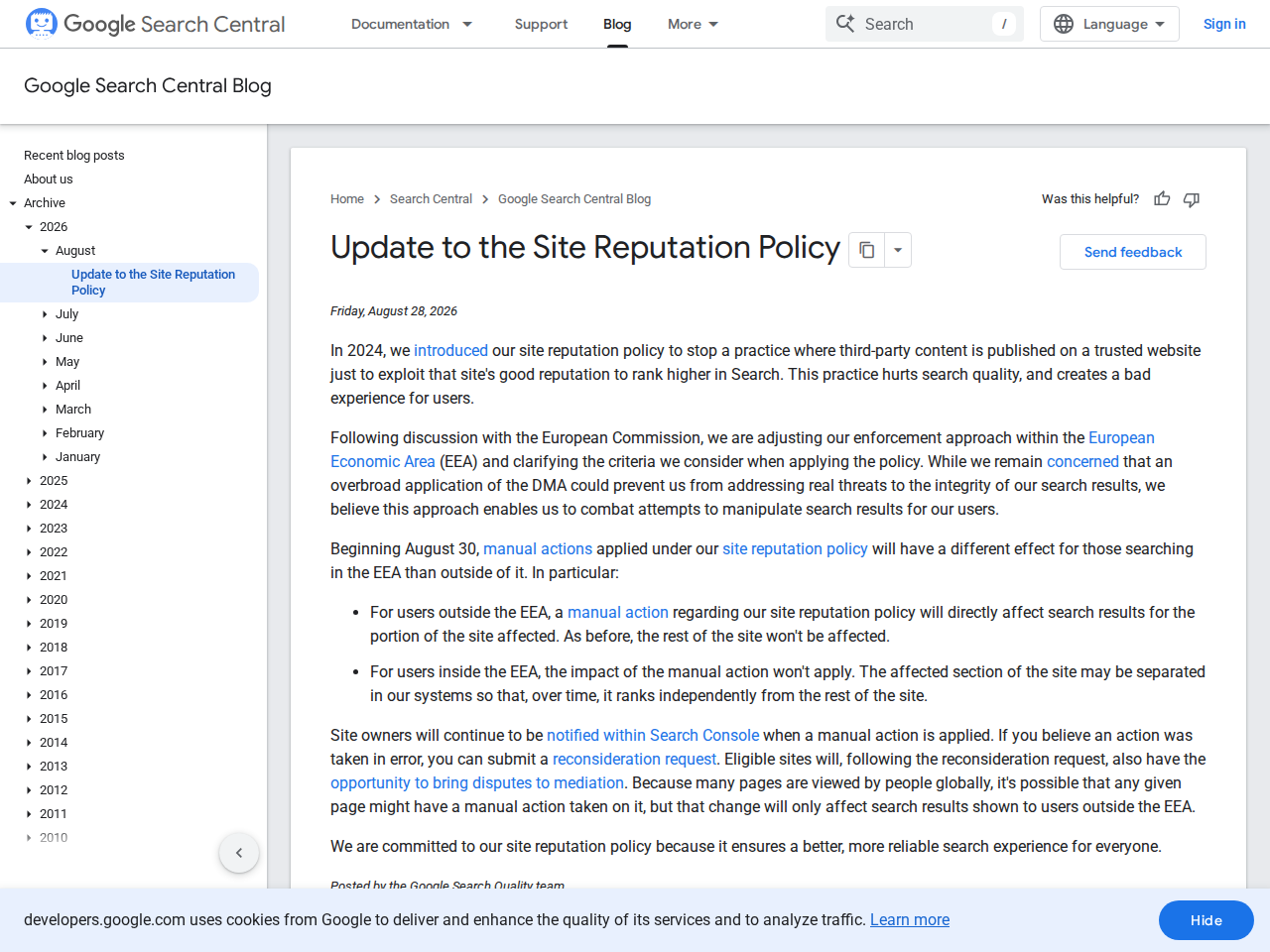
On Friday, August 28, 2026, Google's Search Quality team published a quiet but consequential update to its Site Reputation Policy — the enforcement rule the industry calls "parasite SEO." As of Sunday, August 30, 2026, manual actions issued under this policy no longer display their effect uniformly around the world. Searchers inside the European Economic Area (EEA) will see one version of reality; everyone else — including the US, UK, Gulf, and wider MENA — will see another. This piece breaks down exactly what changed, straight from Google's primary announcement, and what it means for publishers, affiliates, and content teams.
What the Site Reputation Policy actually is
Google introduced the policy in 2024 to counter what its own announcement describes as "a practice where third-party content is published on a trusted website just to exploit that site's good reputation to rank higher in Search." The company's stated rationale at the time, repeated verbatim in the new post, is that the practice "hurts search quality, and creates a bad experience for users."
In practice, the policy swept up some of the most familiar monetization surfaces on the modern web: coupon sections bolted onto news domains, affiliate review hubs riding a magazine's authority, sponsored "deals" pages produced by third parties and published under a legacy brand. The pattern matters more than the label: when a page ranks because of the domain it sits on rather than the editorial value it provides, the policy is the instrument Google uses to intervene — with a manual action that demotes the affected section while leaving the rest of the site untouched.
For content operations, that architecture matters. It means the risk has always been surgical, not fatal: a well-run coupon vertical could theoretically take the hit while the newsroom's core pages kept their rankings. It also explains why the policy became a negotiating table between Google and publishers — and, eventually, between Google and Brussels.
The change: two internets for one index
Beginning August 30, 2026, per Google's announcement, "manual actions applied under our site reputation policy will have a different effect for those searching in the EEA than outside of it." The post then splits the mechanics into two tracks:
- Outside the EEA: nothing changes. A manual action "will directly affect search results for the portion of the site affected," and "as before, the rest of the site won't be affected."
- Inside the EEA: "the impact of the manual action won't apply." Instead, the affected section "may be separated in our systems so that, over time, it ranks independently from the rest of the site."
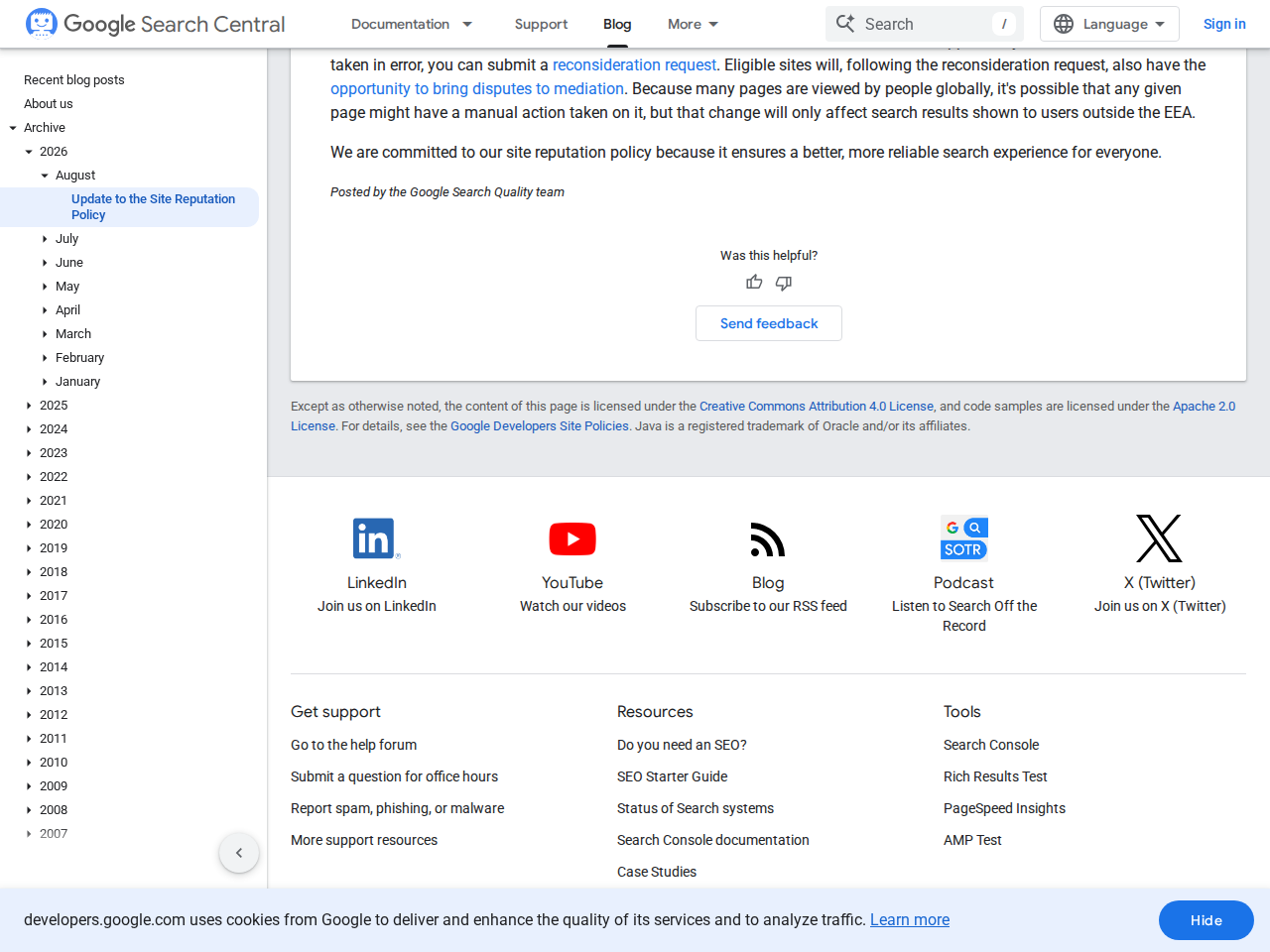
One nuance in the announcement deserves more attention than most coverage gave it. Because pages are viewed globally, Google notes that "it's possible that any given page might have a manual action taken on it, but that change will only affect search results shown to users outside the EEA." Translation: the penalty can still exist inside Google's systems for a European site — it simply stops being displayed in European results. The action is paused in appearance, not abolished in substance.
The operational scaffolding around the policy stays intact. Site owners "will continue to be notified within Search Console when a manual action is applied." Those who believe an action was taken in error can "submit a reconsideration request," and — in a wrinkle specific to this policy — eligible sites will, following the reconsideration request, "also have the opportunity to bring disputes to mediation."
Why now: the Brussels backstory
The announcement is unusually candid about the driver. Google states the adjustment comes "following discussion with the European Commission," while explicitly registering its discomfort: the company remains "concerned that an overbroad application of the DMA could prevent us from addressing real threats to the integrity of our search results," but believes this approach "enables us to combat attempts to manipulate search results for our users."
The DMA — the Digital Markets Act — is the EU's rulebook for platform "gatekeepers," and it hands regulators significant leverage over how large platforms behave toward businesses that depend on them. A search engine unilaterally demoting sections of major publisher domains sits in an awkward place under such a regime: Google frames it as spam enforcement, while a competition authority can reasonably ask whether a gatekeeper is shaping which commercial content European users ever see. Trade coverage has already settled on the same reading; Search Engine Journal called the move a removal of penalties inside the EEA, Search Engine Roundtable documented the non-enforcement in Europe, and Reuters reported it as Google committing to adjust the "parasite SEO" policy to avoid a confrontation with EU regulators.
What gets lost in the loudest headlines is that Google did not retire the policy. The announcement closes by reaffirming commitment to it "because it ensures a better, more reliable search experience for everyone." What changed is where the enforcement is allowed to show its face — a geographic carve-out, not a philosophical retreat.
What the split means in practice, by situation
Publishers monetizing with third-party sections
If your business model includes hosting coupon, deals, or review sections produced by third parties, your risk profile is now officially bifurcated. Outside the EEA — still an enormous share of global search traffic — manual actions bite exactly as they did before. Inside the EEA, the visible demotion lifts, but the announcement's own language points to a slower structural consequence: the affected section may come to rank independently of the host domain. Over time, that is arguably a worse commercial outcome for a parasite-style arrangement than a clean penalty, because the entire premise — borrowing host authority — quietly dissolves.
Brands and affiliates buying visibility on strong domains
If you are the third party — an affiliate operation, a fintech brand, an e-commerce player paying for placement on trusted domains — the calculus has changed twice over. First, the European visibility you were effectively renting may partially return, but on an independent ranking trajectory that could decay as the separation matures. Second, your non-European exposure through those same placements remains fully exposed to enforcement. Any contract signed today for hosted content on a high-authority domain should be priced with a European discount and a non-European risk premium.
Freelance writers and content agencies
A meaningful slice of content-industry freelancing is exactly this work: writing for sections that live on someone else's authoritative domain. Writers should understand that demand for pure "parasite placement" content is structurally declining — the model's economics are eroding on both sides of the Atlantic for different reasons. The durable alternative is the one content professionals have always had: build authority under your own domain or a client's owned property, where editorial value compounds instead of leaking into a host site's equity.
Teams using AI content pipelines
There is a specific irony worth naming. Mass-produced AI content dropped into third-party sections is precisely the low-editorial-value material this policy was built to catch, wherever it runs. If your team leans on AI drafting — whether a general assistant or a purpose-built platform like ARWriter's article and research writer — the defensible pattern is the same: original angles, real sources, human review, published on property you control. The tool is not the risk; the placement strategy is.
Quick comparison: the policy before and after August 30
| Dimension | Before August 30, 2026 | After August 30, 2026 |
|---|---|---|
| Effect of a manual action | Uniform worldwide | Split: full effect outside the EEA, display-suspended inside it |
| Results seen in Paris or Berlin | Reflect the penalty | Penalty effect not applied; affected section may rank independently over time |
| Results seen in New York or Dubai | Reflect the penalty | Reflect the penalty, unchanged |
| Search Console notifications | Available | Unchanged |
| Dispute routes | Reconsideration | Reconsideration, plus mediation for eligible sites |
| The policy itself | Active | Active and reaffirmed |
The honest limits of what we know
A careful read of the announcement leaves real questions open, and pretending otherwise would be malpractice:
- The "separation" mechanism is undefined. Whether the EEA treatment is a subdomain-level filter, a ranking-signal partition, or something else entirely is not disclosed. "May be separated in our systems" is the full extent of the disclosure.
- No timeline commitments. "Over time" is the only schedule Google offered for the independent-ranking transition. Publishers waiting for a defined migration window will not find one.
- No numbers on current actions. Google has not published how many manual actions under this policy are presently live, so any figure circulating in commentary is an estimate, not a fact.
- Eligibility for mediation is unexplained. The post says "eligible sites" will get the mediation option after reconsideration, without defining eligibility.
- The regulatory file stays open. Google's own language — concern about "overbroad application of the DMA" — signals that this settlement is provisional. The enforcement geography could shift again in either direction.
An action checklist for the week after
- Audit Manual Actions in Search Console. Confirm whether any "Site reputation abuse" action exists against your property before theorizing about traffic moves.
- Inventory every third-party section you host. For each, answer two questions in writing: who holds editorial control, and what would a reader lose if it disappeared tomorrow? Sections with no defensible answers are your exposure — in every geography.
- Segment performance by country. Aggregate numbers will now lie to you. Compare EEA versus non-EEA trends separately in your analytics and Search Console reports for at least the next quarter.
- If you carry an action: remediate the section first, then file the reconsideration request, and ask explicitly about mediation eligibility if the outcome disappoints.
- Renegotiate hosted-content deals now. Any agreement priced on European visibility or non-European safety needs new terms that reflect the split — not after the market reprices it.
Three misreadings already circulating
"Google killed the parasite SEO policy." It did not. The policy stands, is explicitly reaffirmed, and continues to generate manual actions; only their visible effect inside one geographic zone changed.
"This is only about European sites." The carve-out follows the searcher's location, not the site's. A Gulf-based coupon network with European traffic is affected in exactly the way a Berlin publisher is — through what European users see.
"Penalized sections will bounce back in Europe." The announcement promises suspension of the penalty's effect, plus gradual independent ranking for the affected section. That second half is a slow de-coupling of borrowed authority, which is closer to a managed decline than a recovery.
Frequently asked questions
What is the EEA exactly?
The European Economic Area: all EU member states plus Iceland, Liechtenstein, and Norway. For this policy, what matters is where the searcher is located, not where the site or its owners are based.
Does this change anything for US or Middle East audiences?
No. Outside the EEA, manual actions under the site reputation policy apply and display exactly as they did before August 30, 2026.
How do I know if my site has a manual action?
Check the Manual Actions report in Google Search Console. That is the only official notification channel; traffic drops alone are never a reliable diagnosis.
Will European rankings recover immediately?
No timeline was promised. The announcement describes the affected section potentially ranking independently "over time," which signals a gradual transition rather than an instant restoration.
Could Google reverse this later?
The framing — a change made after discussion with the European Commission, with Google still voicing concerns about DMA overreach — reads as a negotiated, provisional arrangement. Both a hardening and a softening remain plausible as the regulatory conversation continues.
The real lesson: own your publishing surface
The deepest signal in this update predates it: search visibility is becoming jurisdictional. The same index now renders different realities by region, which means authority you rent from someone else's domain is subject to regulatory weather you don't control. Publishers and creators who spent the last decade building owned surfaces — their domains, their newsletters, their owned content libraries — inherit stability from this split. Everyone else inherits complexity.
If you publish in Arabic or run multilingual content operations, tools that consolidate research, drafting, visuals, and publishing in one owned workflow — such as the ARWriter platform or its individual content tools — are one practical way to keep production quality high without depending on borrowed domain authority. The store also carries ready-made content solutions for teams that prefer done-for-you packages.
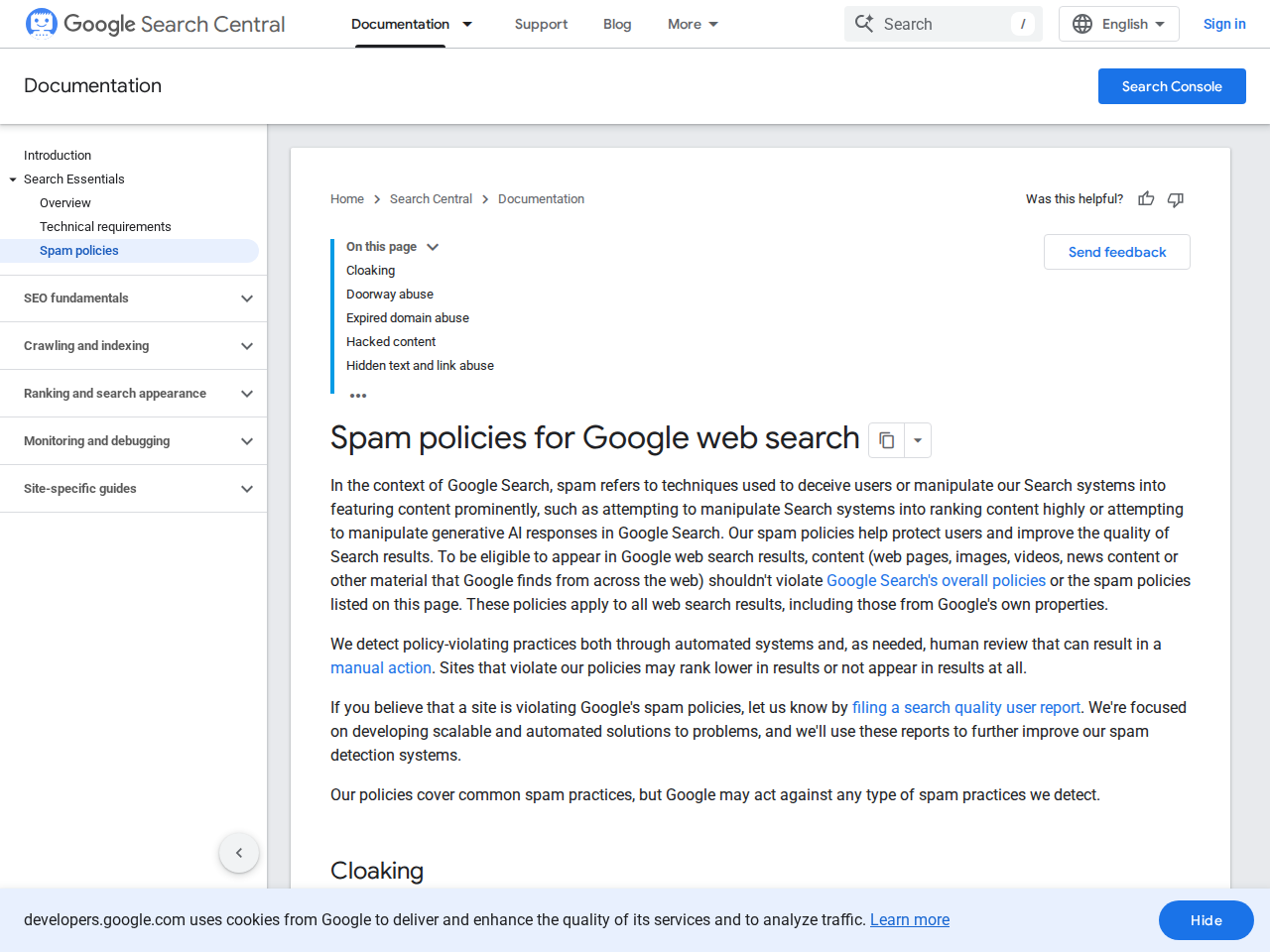
Sources: Google Search Quality team, "Update to the Site Reputation Policy," Google Search Central Blog, August 28, 2026 (primary source); Search Engine Journal and Search Engine Roundtable coverage, August 27–28, 2026; Reuters via MSN. All screenshots captured from official pages on August 30, 2026.