Anthropic has published the first full revision of its Usage Policy in over a year, and the new text takes effect on November 12, 2026. Posted on October 8, the update rewrites the rules for everyone who submits inputs to Claude — through the app, the API, or any reseller. Four areas drive the change: a first-of-its-kind rule against sustained cruelty toward the model itself, a consolidated ban on deceptive campaigns and artificial activity, sharper election-integrity language, and expanded restrictions on weapons and surveillance. Here is what actually changed, what did not, and what it means for your workflow.
The headline change: cruelty toward Claude is now a named violation
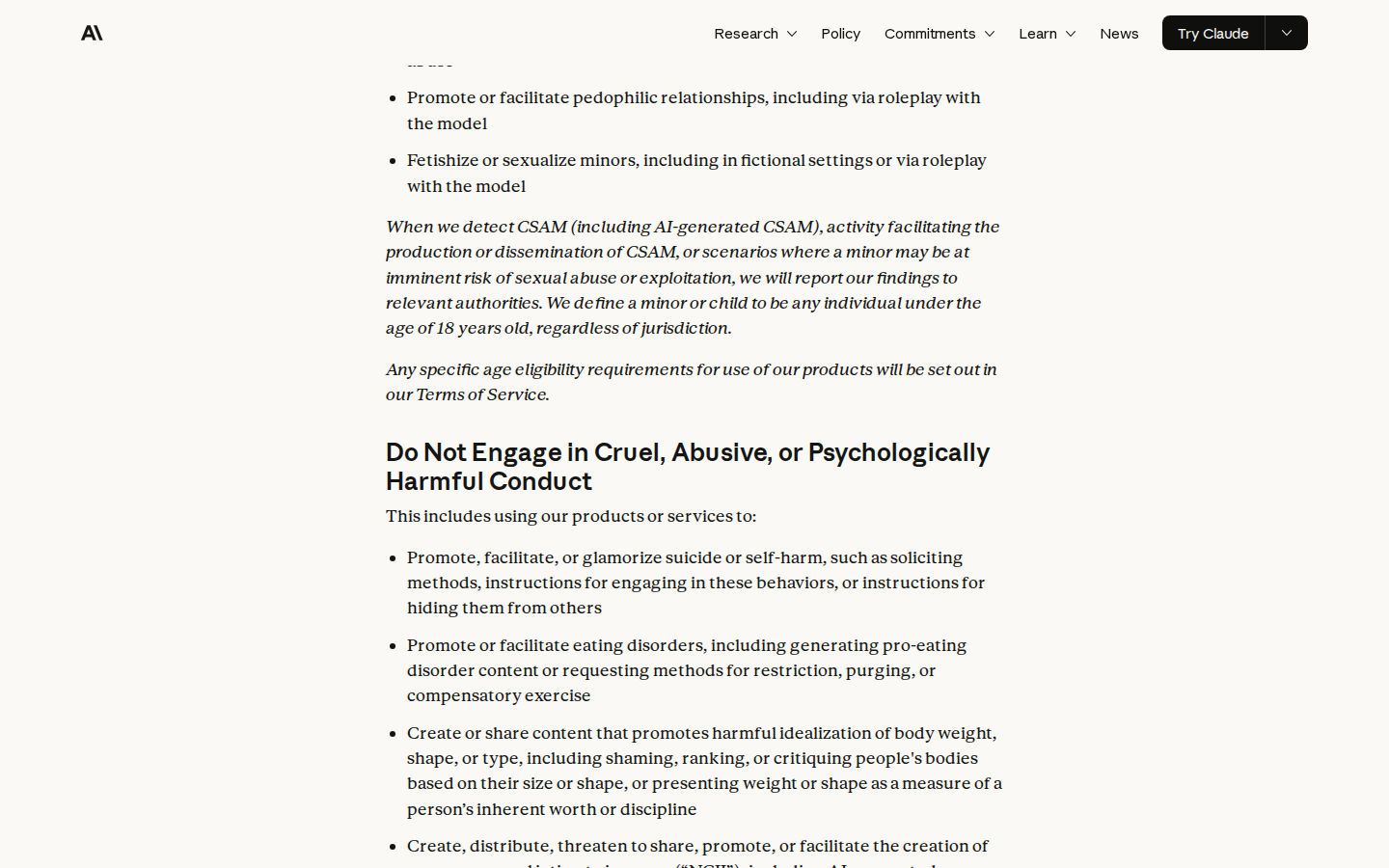
The section everyone is talking about prohibits "sustained and needless abusive or cruel behavior" directed at Claude itself. This is not a sudden whim: since August 2025, Claude has been allowed to end conversations with "persistently harmful or abusive" users as part of Anthropic's research into model welfare. The updated policy keeps conversation termination as the "primary enforcement mechanism" — Anthropic declined to comment on whether account bans or other penalties will follow.
The company scoped the rule narrowly in its own words: it "is meant to apply only in extreme cases, where users repeatedly act cruelly toward our models, with no discernible purpose. It does not apply to common versions of user frustration, pushback, dark creative themes, or model testing and research." That last clause matters for writers: dark fiction, stress-testing prompts, and blunt feedback all remain explicitly allowed. The industry, notably, is not aligned on any of this — Microsoft AI's recent code of conduct draft took the opposite position, stating that "the idea of model welfare is wrong," before softening the wording. Anthropic is now the first major lab to elevate the concept into an enforceable document.
The part that should actually get your attention: artificial activity
Beyond the model-welfare debate sits a change with real operational consequences. Scattered older restrictions have been merged into a single new ban on "Deceptive Campaigns or Artificial Activity." The text prohibits using Anthropic's products to:
- Create or operate fake personas, accounts, media outlets, or organizations, or impersonate real people or publications — with sockpuppets, astroturfing, fake reviews, and "bots that claim to be human" called out by name.
- Misrepresent or intentionally conceal the sponsorship of content intended to influence public opinion, officials, or decision-makers.
- Distribute content through networks of fake or ostensibly independent outlets, websites, or accounts.
- Deceive voters — including misinformation about candidates or how to vote, impersonating candidates or election officials, or suppressing turnout.
If your growth playbook involves generating "independent" reviews, seeding personas across platforms, or laundering sponsored messaging through unmarked channels, the policy now names your strategy explicitly. The same logic applies to so-called "independent news networks" that are really one operator with a spreadsheet of sites. Disclosure is the safe line: paid and AI-assisted campaigns remain permissible; hiding who is behind them does not.
Weapons, surveillance, health, and finance
Three more areas were tightened. The weapons ban, always present on paper, now covers "software and components that make weapons work, as well as actions like arming drones and other autonomous vehicles" — a response, Anthropic says, to repeated real-world attempts. The surveillance rules got clearer teeth: "Tracking people without their consent is prohibited, whether it happens in real time or through analysis of previously collected data," and Claude may not be used to decide or recommend who to investigate, arrest, or charge. New high-risk sections also address health and financial uses, continuing an industry-wide push to fence off sensitive advice in those domains.
What this means for you as a content creator
- Audit any review-generation workflow. Drafting genuine customer reviews for approval by real customers is fine; fabricating reviewers is now a named violation. If you scale content across accounts, keep one accountable identity per channel — coordination through a single team is safer than a web of fake ones.
- Label sponsored AI content. The enforcement direction is global and one-way. The EU's watermarking push for AI text — which we covered in our textGrain explainer — and this policy converge on the same principle: provenance transparency.
- Keep your edge, drop the worry. Horror scripts, gritty fiction, blunt prompt iteration — all explicitly protected. You do not need to soften your creative work.
- Building on the API? The policy binds your product too. If your app invents personas or masks attribution, the exposure is yours, not just Claude's.
- Your bill is untouched. This is a policy revision, not a pricing event. Nothing here changes plan costs on any provider.
Quick comparison: where the big labs stand
| Policy area | Anthropic (Nov 12, 2026) | OpenAI | Google (Gemini) |
|---|---|---|---|
| Fake reviews & sockpuppets | Named, dedicated section | Prohibited under misuse policies, less granular | Prohibited under conduct rules |
| Cruelty toward the model | Banned in extreme cases — first among major labs | No equivalent clause | No equivalent clause |
| Concealed sponsorship | Explicit ban | Barred under deception rules | Barred under deception rules |
| Model-welfare stance | Active research program | Not a policy pillar | Not a policy pillar |
Honest limitations of this update
- Enforcement is still mostly "Claude hangs up." Without published ban mechanics, the model-welfare rule may prove more symbolic than punitive in the near term.
- Broad phrasing. "Artificial activity" and "deceptive campaigns" leave room for inconsistent interpretation across reviewers and borders.
- It governs Anthropic's products only. Platform rules on Instagram, TikTok, X, or LinkedIn are separate — and often stricter about AI-generated content disclosure.
- No grandfathering detail was published for enterprise workflows that may currently rely on persona-based features; teams building on Claude should re-check the full text before November 12.
The practical takeaway
Read this update as a compliance preview of where the whole industry is heading: attribution and disclosure are becoming load-bearing requirements for anyone publishing at AI speed. The creators who adapt early — clear labels, real identities, honest reviews — inherit the trust that late movers will have to buy back. If you want a workspace where Arabic and English content, images, and scheduling live under one accountable roof instead of scattered anonymous accounts, look at ARWriter — plans start at $4.99/month, and the prompt library is a good place to standardize your team's voice before policy season gets stricter.
Frequently asked questions
Does the new Anthropic policy ban AI-written marketing copy?
No. Clearly attributed marketing and AI-assisted copy are allowed. What is prohibited is obscuring sponsorship or distributing the content through fake accounts, personas, or ostensibly independent outlets.
Can my account be banned for being rude to Claude?
The stated primary enforcement is Claude ending the conversation, not account termination. Anthropic scoped the rule to extreme, repeated, purposeless cruelty and explicitly excluded everyday frustration, pushback, dark creative themes, and testing.
When exactly does the new Usage Policy take effect?
November 12, 2026. Until then the previous version — effective September 15, 2025 — remains the governing text, with the new version published in advance for review.
Is dark or violent fiction still allowed under the psychological-harm section?
Yes. The policy text carves out "dark creative themes" explicitly. The section targets content promoting self-harm, eating disorders, and body-shaming — not fiction.
Does any of this change Claude's pricing or availability?
No. The October 8 update is a usage-policy revision only. No pricing, quota, or regional-availability changes were announced alongside it.
Primary source: Anthropic Usage Policy (effective November 12, 2026), including the linked previous version on Anthropic's site. Announcement dated October 8, 2026.