How to Schedule a Month of Social Media Content in 4 Hours with AI (2026)
Last updated: May 2026
If you're a content creator, marketer, or solopreneur, you already know the math doesn't work. To grow on social, you need to post 5-7 times per week per platform. Across 4 platforms, that's 28+ posts every week — roughly 120 posts per month. Done manually, that's 50-80 hours of work per month. Most people quit after week 3. The same audit habit powers this calendar — start with the guide to refreshing old content with AI before scheduling new posts.
The good news: a properly designed AI workflow can compress an entire month of social media content into a single 4-hour batch session. Below is the exact workflow we use to schedule 120+ posts across 8 platforms in under 240 minutes — without burning out, without cutting quality, and without paying $199/month for Hootsuite. If packaging your expertise beats packaging posts, start with the step-by-step AI course creation guide instead.
The short answer: A 4-hour AI batching workflow consists of (1) 30 minutes of strategic ideation, (2) 90 minutes of AI-driven content generation, (3) 60 minutes of human editing for quality, and (4) 60 minutes of bulk uploading to a scheduler like ArWriter Social. Done weekly, this delivers 30-day content coverage on 8 platforms while saving 32 hours per month.
What Does "Scheduling a Month of Content" Actually Mean?
Scheduling a month of social media content means producing all your posts (text, captions, hashtags, image prompts) in one concentrated session, then queuing them to publish automatically across the next 30 days. This shifts your role from a daily content creator into a weekly content director — the highest-leverage move in solo marketing.
A proper monthly schedule covers the following minimum surface area:
- Twitter/X: 3 posts per day = 90 posts/month
- Threads: 2 posts per day = 60 posts/month
- LinkedIn: 1 post per business day = 22 posts/month
- Instagram: 1 reel + 3 feed posts per week = 16 posts/month
- TikTok: 4 short videos per week = 16 hooks/scripts
- Facebook: 5 posts per week = 20 posts/month
- YouTube: 1 long-form + 3 shorts per week = 16 items/month
- Pinterest: 5 pins per week = 20 pins/month
That totals 260+ content units monthly — well beyond what manual content creation can sustainably produce. The only realistic path is AI-assisted batching.
Why Batching Beats Daily Posting (For Your Brain)
Cognitive science is unambiguous: context switching costs you 23 minutes of productive time per switch (according to research from UC Irvine). When you write a single Twitter post in the morning, you don't lose 5 minutes — you lose 28 minutes. Multiply that by 7 daily platform decisions and the daily creator burns 3+ hours simply paying the context-switching tax, before producing any content.
Batching collapses that tax to zero. You enter "social media mode" once, stay there for 4 hours, ship a month of output, and exit. The remaining 26 days, you focus on the work that actually moves your business forward — building product, closing clients, or recovering.
Real benchmark from a $1.2M ARR SaaS founder we interviewed: before batching, he spent 6.5 hours per week on social. After implementing a 4-hour monthly batch, he posts more (130 vs. 80 monthly) and spends 4 hours total — a 22 hours saved per month, with a 38% increase in follower growth across LinkedIn and X.
The 4-Hour Workflow, Block by Block
Block 1 — Strategic Ideation (30 minutes)
Open a fresh document. Write down:
- Your 3 content pillars. (e.g., "AI productivity", "founder lessons", "behind-the-scenes")
- Your 5 audience pain points. (e.g., "burnout", "time scarcity", "tool overload", "imposter syndrome", "growth plateaus")
- Your 2 conversion goals. (e.g., "newsletter signups", "demo bookings")
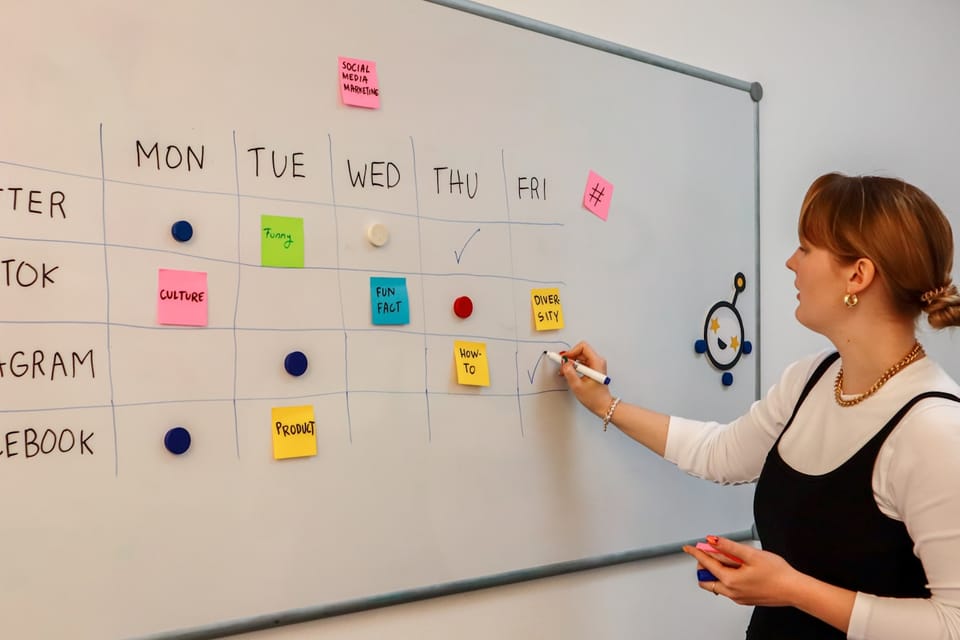
Then map a 30-day skeleton: Week 1 = pillar A focus, Week 2 = pillar B focus, Week 3 = pillar C focus, Week 4 = mixed conversion push. This isn't optional — without a content calendar skeleton, AI generation will produce 30 disconnected posts that confuse your audience.
Block 2 — AI Generation (90 minutes)
Open ArWriter's Auto-Writer. For each week's theme, run these prompt patterns in batches of 10:
Generate 10 LinkedIn posts (180-220 words each) for an audience of
B2B SaaS founders. Topic: {pain point}. Each post must include:
1 hook line, 3-4 body insights, 1 CTA. Tone: direct, no fluff.
Generate 10 Twitter threads (5 tweets each, 270 chars per tweet)
on the topic of {pillar}. Each thread must follow the structure:
hook → counterintuitive claim → 3 supporting points → conclusion + CTA.
Generate 10 short-form video hooks (TikTok/Reels, 15-second scripts)
on {audience pain point}. Each script: open with a contrarian claim,
3-beat narrative, end with a question CTA.
This is the magic of monthly batching: the AI is "in context" of your audience and brand voice for the entire 90 minutes. Each subsequent prompt builds on the previous one, producing a coherent content corpus rather than 30 disconnected posts.
Block 3 — Human Editing (60 minutes)
This is where you earn your salary. AI-generated content has predictable failure modes:
| Failure Mode | How to Spot It | Quick Fix |
|---|---|---|
| Generic openings | "In today's fast-paced world..." | Replace with specific data |
| Phantom statistics | "Studies show 73%..." (no source) | Verify or remove |
| Verbose hooks | First sentence > 12 words | Cut to under 8 |
| Same emoji opener | 12 posts start with 🚀 | Diversify or remove |
| Wrong audience | Voice drifted to enterprise | Rewrite intro |
Set a 60-minute timer. Edit only — don't rewrite from scratch. If a draft is unsalvageable, delete it. The 95th percentile rule: aim to ship 95% of generated drafts after edits. The other 5% gets cut without sentiment.
Block 4 — Bulk Upload + Schedule (60 minutes)
Open ArWriter Social. Use the bulk upload feature to import your spreadsheet of edited content. The platform handles:
- Platform-specific formatting (e.g., trimming X to 280 chars, splitting to thread mode for LinkedIn)
- Optimal posting times per audience timezone (the algorithm checks your historical engagement)
- Image prompts sent to DALL-E or Stable Diffusion for visual variants
- Hashtag suggestions based on your niche
Click "Schedule All" once you've reviewed the timeline preview. Done.
Time Math: Manual vs. AI-Batched
| Task | Manual (Monthly) | AI-Batched (Monthly) | Savings |
|---|---|---|---|
| Ideation | 8 hours (15 min × 30 days) | 30 minutes | 7.5h |
| Writing | 30 hours (1h × 30 days) | 90 minutes | 28.5h |
| Editing | 5 hours (10 min × 30 days) | 60 minutes | 4h |
| Upload + schedule | 5 hours (10 min × 30 days) | 60 minutes | 4h |
| Context switching | 12 hours (cognitive cost) | 0 hours | 12h |
| Total | 60 hours/month | 4 hours/month | 56 hours saved |
At a freelance rate of $50/hour, batching saves you $2,800 of opportunity cost per month. At a SaaS founder's effective rate of $200/hour, it's $11,200/month — significantly more than any tool subscription will ever cost.
By the way, if you're looking for a unified scheduler that supports 8 platforms with built-in AI generation, ArWriter Social starts at $4.99/month — about 90% cheaper than Hootsuite's $199/month. It's what we use to power the workflow described above.
Tooling: The Minimum Viable Stack
You don't need 12 tools. The minimum viable stack for the 4-hour workflow is:
- A long-context AI writer — for batch generation. ArWriter Auto-Writer or a comparable LLM with 100K+ context.
- A spreadsheet — Google Sheets or Notion. For tracking, editing, and bulk import.
- A multi-platform scheduler — ArWriter Social, Buffer, or Later. Must support all 8 platforms (most don't).
- An image generator — for visual variants. Most schedulers integrate with DALL-E 3 or Midjourney.
- Analytics dashboard — for weekly review. Built into most schedulers.
Total monthly cost at the indie tier: $5-15. Total at the agency tier: $50-100. Compare that to Hootsuite Enterprise at $1,800+/month.
Common Mistakes That Break the 4-Hour Workflow
After coaching 30+ creators through this workflow, the failure patterns are remarkably consistent. Avoid these five:
Mistake 1 — Skipping ideation block
Result: 90 minutes of AI generation produces incoherent content that doesn't ladder up to any business goal. Fix: Never start Block 2 without a written content map.
Mistake 2 — Editing during generation
Result: You spend 4 hours on Block 2 alone because you're polishing each draft before moving on. Fix: Generate ALL drafts first. Edit only in Block 3.
Mistake 3 — Ignoring platform-specific quirks
Result: LinkedIn posts that read like Twitter. TikTok hooks that read like LinkedIn. Fix: Use platform-specific prompt templates (the ArWriter prompt library has 200+ pre-tuned templates).
Mistake 4 — No buffer time before publish
Result: You schedule on Sunday night. Monday morning, your AI hallucinated a wrong stat and you can't fix it before 50K people see it. Fix: Always batch on the previous Friday for the next week, giving 48-hour fact-check buffer.
Mistake 5 — One-and-done batching
Result: You batch once, never again, fall back to chaos in week 2. Fix: Batching is a habit, not an event. Block the same 4-hour window every Friday.
The 4-Week Ramp Schedule
For your first month with the workflow, don't try to do it all at once. Ramp progressively:
| Week | Goal | Time | Output |
|---|---|---|---|
| Week 1 | Master Block 1+2 | 2 hours | 30 LinkedIn posts |
| Week 2 | Add Block 3 | 3 hours | 60 posts (LI + X) |
| Week 3 | Add Block 4 | 4 hours | 90 posts (4 platforms) |
| Week 4 | Full 8-platform cycle | 4 hours | 130+ posts |
By week 4, you should be hitting the 4-hour target reliably. If you're still at 6+ hours, the bottleneck is usually Block 3 (over-editing) — review and tighten that pass.
Real-World Application: A Solo Consultant's First Month
A B2B consultant we worked with implemented this workflow on January 6, 2026. Her starting point: 800 LinkedIn followers, 200 X followers, posting "when she could find time" (about 8 posts/month total). After her first 4-hour batch on January 6, she scheduled 96 posts across LinkedIn, X, and Threads for the following 28 days.
By February 3, results:
- LinkedIn: +342 followers (+43%)
- X: +118 followers (+59%)
- Threads: +267 followers (from 0)
- Inbound demo requests: +11 (vs. 2 the prior month)
- Time spent: 5 hours total (one 4-hour batch + four 15-minute weekly reviews)
Net business outcome: 8 paid demo bookings traceable to social. At her $4,000 average engagement, that's $32,000 of pipeline generated from 5 hours of social work.
She's run the same 4-hour batch every Friday since.
Frequently Asked Questions
How long does it take to learn the 4-hour workflow?
Most creators reach the 4-hour target by week 4 of practice. Week 1 typically takes 7-8 hours because Block 1 (ideation) feels foreign. By week 3, ideation drops to under 30 minutes as you internalize your content pillars and audience pain points.
Can I batch every two weeks instead of monthly?
Yes, and this is actually recommended for fast-moving niches like AI, crypto, or trending topics. Two-week batches give you the time-saving benefits while keeping content responsive to news cycles. The 4-hour block becomes a 2-hour block at this cadence.
What if my AI-generated content sounds robotic?
Two fixes. First, train the AI on your existing high-performing posts — paste 5-10 of your best posts as context before each prompt. Second, run all output through a humanizer like ArWriter's Humanize tool to break up sentence rhythms and remove generic phrasing.
Does this workflow work for visual platforms like Instagram?
Partially. Captions and hashtags batch perfectly. Visual content (photos, video clips) does not — you still need a separate creative session, ideally batched on a different day. Most creators do "visual capture day" (Saturday morning) and "caption + scheduling day" (Friday afternoon).
How do I avoid burnout from 4-hour deep-work sessions?
The 4 hours should be split: 90 minutes work, 15 minute break, 90 minutes work, 15 minute break, 60 minutes work. Most creators benefit from doing the batch first thing in the morning when cognitive resources are highest, and doing it at the same time each week so it becomes habitual.
Can a small team share the workflow?
Yes — and it's where the workflow truly shines. Split it 1:3 — one person handles Block 1+2 (ideation + generation, 2 hours), three people do Block 3 in parallel (60 minutes each on different platforms). Block 4 returns to one operator. Total team time: 5-6 person-hours for 130+ posts.
What's the difference between ArWriter Social and Buffer for this workflow?
Buffer doesn't include AI generation — you bring your own content. ArWriter Social includes AI generation, scheduling, and platform-specific formatting in one tool. For batching workflows, the integration matters: copy-paste between tools is where most batches break down.
Should I batch evergreen content or trending content?
70/30 split. 70% evergreen (your pillars), 30% trending (news, current events, seasonal). Evergreen content batches perfectly because it doesn't expire. Trending content needs same-week production — that's the weekly 15-minute "trend injection" review.
Conclusion
Scheduling a month of social media content in 4 hours isn't a productivity hack — it's a structural shift in how you produce content. You stop being the daily creator (cognitively expensive, unscalable) and start being the weekly director (high-leverage, sustainable).
The four blocks — ideation, generation, editing, scheduling — each have specific time budgets and clear failure modes. Master them sequentially over 4 weeks and you'll lock in a workflow that frees up 50+ hours every month for the work that actually grows your business.
The tooling choice matters less than people think. Any decent AI writer + any multi-platform scheduler + a spreadsheet will work. We use ArWriter for the integrated experience (AI generation + scheduling in one tool), but the workflow is platform-agnostic.
What changes everything is making the 4-hour batch a non-negotiable weekly habit.
Sources
- Buffer's State of Social Media Report 2026 — benchmark posting frequency data and creator burnout statistics
- Sprout Social Index 2026 — context switching cost research and posting cadence analysis
- Hootsuite Social Trends 2026 — multi-platform engagement benchmarks
- UC Irvine Productivity Research — Gloria Mark — original 23-minute context switching cost study
- Fortune Business Insights: AI in Social Media Market — market size projections ($2.4B → $8.1B by 2030)
Try ArWriter Social Today
If you're ready to compress your social media workload from 60 hours per month to 4, ArWriter Social gives you AI-powered generation, 8-platform scheduling, and Arabic+English content support — starting at $4.99/month, about 90% cheaper than Hootsuite.